
When musicians say they want their recordings to sound professional, what do they actually mean?
Clear? Loud? Polished? Perfectly edited?
Similar to the biggest records in their genre?
Those things can all be part of a professional production.
But none of them should require you to remove everything that makes your music sound like you.
More...
You've hit a wall with your audio skills and can't seem to improve your sound, no matter what you do?
See if you are a great fit for The Self-Recording Syndicate!
It is the number one way for DIY producers around the world to get results that they'll be proud of forever.
- Grow your audience with songs that don't sound "demo-y".
- Be taken seriously by your peers, fans and other musicians.
- Make records that sound as good as your favorite songs in your playlist.

Here's how to get there:
Apply for unlimited, personal 1-on-1 coaching (results guaranteed) - This is by far the fastest and best way to achieve your goals. Your gonna be working 1-on-1 with an experienced studio pro until your project is done. On your own songs, from your (home) studio and in your DAW of choice.
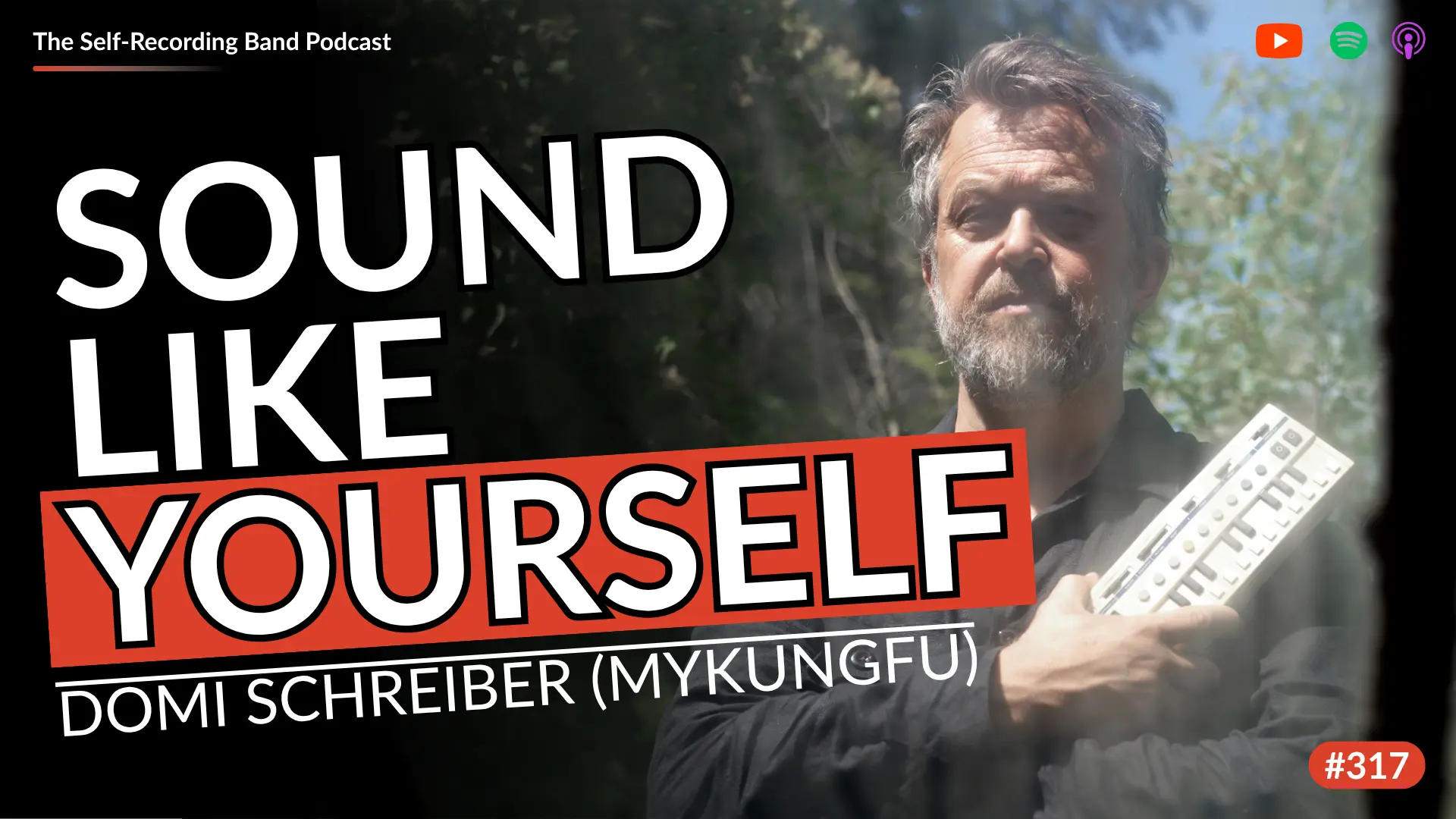
That tension sits at the heart of our conversation with Domi Schreiber, the Swiss musician behind MyKungFu.
Domi has spent decades making music. But when he started taking more control of his own recording, production, and mixing, he had to figure out something deeper than simply learning how compressors and microphones work:
How do you make a record sound professional without polishing away its personality?
Domi was also a member of The Self-Recording Syndicate and worked with us through 1-on-1 coaching while developing the skills to produce and mix his own music.
Sounding Different Doesn’t Mean You’re Doing It Wrong
For a long time, Domi saw sounding different as a weakness.
If his music didn’t resemble other professional releases, maybe that meant he simply wasn’t good enough yet.
That is an easy trap to fall into.
You reference a commercial record.
Then yours sounds different.
So you assume the professional record is the target and your job is to close the gap.
But what if some of that difference is exactly what makes your music interesting?
Domi’s music combines influences ranging from guitar-driven rock to Radiohead, electronic textures, unusual percussion, warm production, sparse arrangements, and strong melodies.
His goal isn’t to reproduce someone else’s sonic identity.
It’s to make something that feels like MyKungFu.
Professional Doesn’t Mean Polished to Death
Domi had previously worked on productions where more and more editing and processing gradually made the music feel colder to him.
Drums were tightened.
Parts were edited.
Vocals were heavily controlled.
Everything became cleaner.
But something important was disappearing.
For Domi, noises, imperfections, darker tones, and the natural behavior of instruments can all be part of the emotional character of a recording.
That doesn’t mean mistakes are automatically good.
It means you shouldn’t remove something merely because it isn’t technically perfect.
The better question is:
Does it help or hurt the song?
If an imperfection contributes emotion, personality, or movement, fixing it may actually make the record worse.
“Professional” Is Not One Specific Sound
One of the biggest ideas in this episode is that there isn’t one correct version of professional production.
A bright, punchy, aggressively compressed modern mix can sound professional.
So can something darker, warmer, quieter, more dynamic, and more organic.
Domi has a particularly strong preference for the latter.
That became obvious when Benedikt mastered some of his mixes.
Even relatively small changes toward more brightness, loudness, or polish could move the result away from how Domi wanted his music to feel.
The solution wasn’t deciding who was objectively right.
It was understanding the artist’s intention and finding the point where the record felt finished without changing its identity.
Your Taste Matters More Than the Recipe
Domi says one of the biggest lessons he took from the coaching was realizing that record production wasn’t about finding the right thing to do.
It was about finding the right thing for his music.
That distinction matters.
A compressor does not need to be used because “professional vocals are compressed.”
A guitar does not need to be brighter because another record has bright guitars.
A performance does not need to be quantized because the grid says it is slightly late.
Every tool is there to solve a problem or create an effect.
If you don’t need that effect, you don’t need the tool.
Learning the technical side of production gave Domi more choices.
And eventually, those choices became creative freedom rather than technical obligations.
Fewer Elements Can Make Every Decision More Important
Another defining part of Domi’s productions is the arrangement.
His songs often leave space.
There may be a bass line, a groove, a vocal, a guitar or synth texture, and a handful of important supporting elements.
That means there isn’t much to hide behind.
Every sound matters.
A dense arrangement can sometimes disguise a weak tone or an unnecessary part.
A sparse arrangement exposes everything.
But it also allows unusual sounds, strong melodies, and small details to carry much more emotional weight.
Domi says he has learned to enjoy taking things away rather than automatically adding more.
That is an important production skill:
Before adding another layer, ask whether the song actually needs one.
Weird Sounds Can Become Your Signature
Domi’s fascination with unusual sounds goes back years.
Instead of limiting himself to guitars, drums, and synthesizers, he has experimented with typewriters, household objects, mechanical percussion, Pocket Operators, Omnichords, and other sound-making devices.
That carries over into his live performances too.
One setup used small MIDI-controlled mechanical hammers striking glasses, bottles, and other objects.
The electronic sequence controlled the rhythm.
But the audience could physically see and hear the objects creating the sound.
That distinction matters to Domi.
Technology isn’t there to make the performance sterile.
It can be used to create something physical, surprising, and personal.
Collaboration Doesn’t Mean Giving Up Creative Control
Self-producing also doesn’t mean doing everything alone.
Domi brought drummer Martin Fischer into several productions.
They first recorded multiple songs in a studio, but some performances didn’t yet feel right.
Not because the drummer was bad.
The intensity, cymbal choices, snare sound, or groove simply didn’t fit Domi’s vision.
So they worked on the parts again.
In one case, the right answer was dramatically simpler: essentially kick and snare instead of a more elaborate performance.
That’s a great example of collaboration working properly.
The artist communicates what the song needs.
The musician brings expertise and ideas.
Then both listen until the performance feels right.
Learning the Technical Side Creates Freedom
Domi had been playing music for around 30 years before seriously diving into the technical side of production.
Compression, gain staging, automation, microphones, mixing workflows, and recording systems initially felt intimidating.
That’s common.
Technical knowledge can feel like the opposite of creativity.
But once the basics stop being mysterious, something changes.
Instead of thinking:
“I hope I’m doing this correctly.”
you can start thinking:
“What could I do with this?”
Domi describes that shift as freedom.
He can now capture ideas himself, control his recordings, build alternate live arrangements, prepare stems, and make production decisions without depending on someone else for every technical step.
The Studio Version and Live Version Don’t Have to Match
Another interesting part of Domi’s approach is that he doesn’t insist on recreating the record exactly on stage.
A song might be fully produced in the studio but performed as a duo.
Another might use mechanical percussion.
Another might become almost electronic.
Another could be played with a full band.
That flexibility creates a different experience for the audience instead of treating the show as a reproduction of the recording.
The record should be the best version of the record.
The live performance should be the best version of the song for that specific room, audience, and lineup.
They don’t have to be identical.
Making Great Music Isn’t Enough If Nobody Hears It
Once Domi became more confident producing his own songs, another challenge appeared:
Getting people to hear them.
He has since been learning the promotion side too, experimenting with Meta ads, short-form video, playlist outreach, and regular releases.
That work helped grow his Spotify monthly listeners from roughly 77 to around 2,500 at the time of recording.
His point isn’t that streaming numbers determine whether music is good.
They don’t.
But after putting enormous effort into making the songs, he wanted to give them an actual chance to find people who might connect with them.
Sound Like Yourself
Probably the most important lesson from Domi’s journey is that technical skill should not move you toward sameness.
It should give you more control over your differences.
Learn to record well.
Learn what compression does.
Learn editing.
Learn microphones.
Learn mixing.
But then use those skills to make the music more like your vision, not more like everybody else.
A professional record can be warm.
It can be imperfect.
It can be strange.
It can be sparse.
It can be dark.
It can contain sounds nobody else would have chosen.
Professional doesn’t mean generic.
And it definitely doesn’t mean boring.
Listen to the Episode
Episode 317: Sounding Professional Doesn't Mean Generic, Boring, Or “Overproduced” – Domi Schreiber (MyKungFu)
Watch the Episode
In This Episode
- Why sounding professional doesn’t mean sounding generic
- Finding confidence in a sound that is different
- Professional production vs overproduction
- Keeping warmth, personality, and imperfections
- Developing your own sonic identity
- Why sparse arrangements can be powerful
- Using unusual instruments and found sounds
- Knowing when not to edit something
- Learning compression, automation, and mixing
- Why technical knowledge can create creative freedom
- Collaborating with musicians while protecting your vision
- Turning studio songs into different live experiences
- Why independent musicians should learn basic recording skills
- Promoting music through Meta ads and playlist outreach
- Why finishing is more important than perfection
About Domi Schreiber / MyKungFu
Domi Schreiber is a Swiss musician, songwriter, guitarist, singer, and producer releasing music under the name MyKungFu.
His music combines acoustic and electronic elements, unusual textures, strong melodies, and a deliberately personal production aesthetic.
Website:
Spotify:
https://open.spotify.com/artist/6euNZf0xBvNa7VRAY5D0u6?si=C7iJXgXUQuKZqcVfG-o7BA
Apple Music:
https://music.apple.com/ch/artist/mykungfu/316093899
Patreon:
https://www.patreon.com/mykungfu
Ready To Transform Your Sound And Workflow?

Apply for professional mentoring and book a free clarity call with Benedikt to see if our programs are a great fit for you!
Recommended Free Downloads:
Standout Mixes – The DIY Musician’s Guide To Exciting Mixes That Connect
Follow And Connect With Us:
Outback Recordings (Benedikt's Mixing Studio and personal website)
Manel's Website
TSRB Instagram
Benedikt's Instagram
Manel's Instagram
If you have any questions, feedback, topic ideas or want to suggest a guest, email us at: podcast@theselfrecordingband.com