
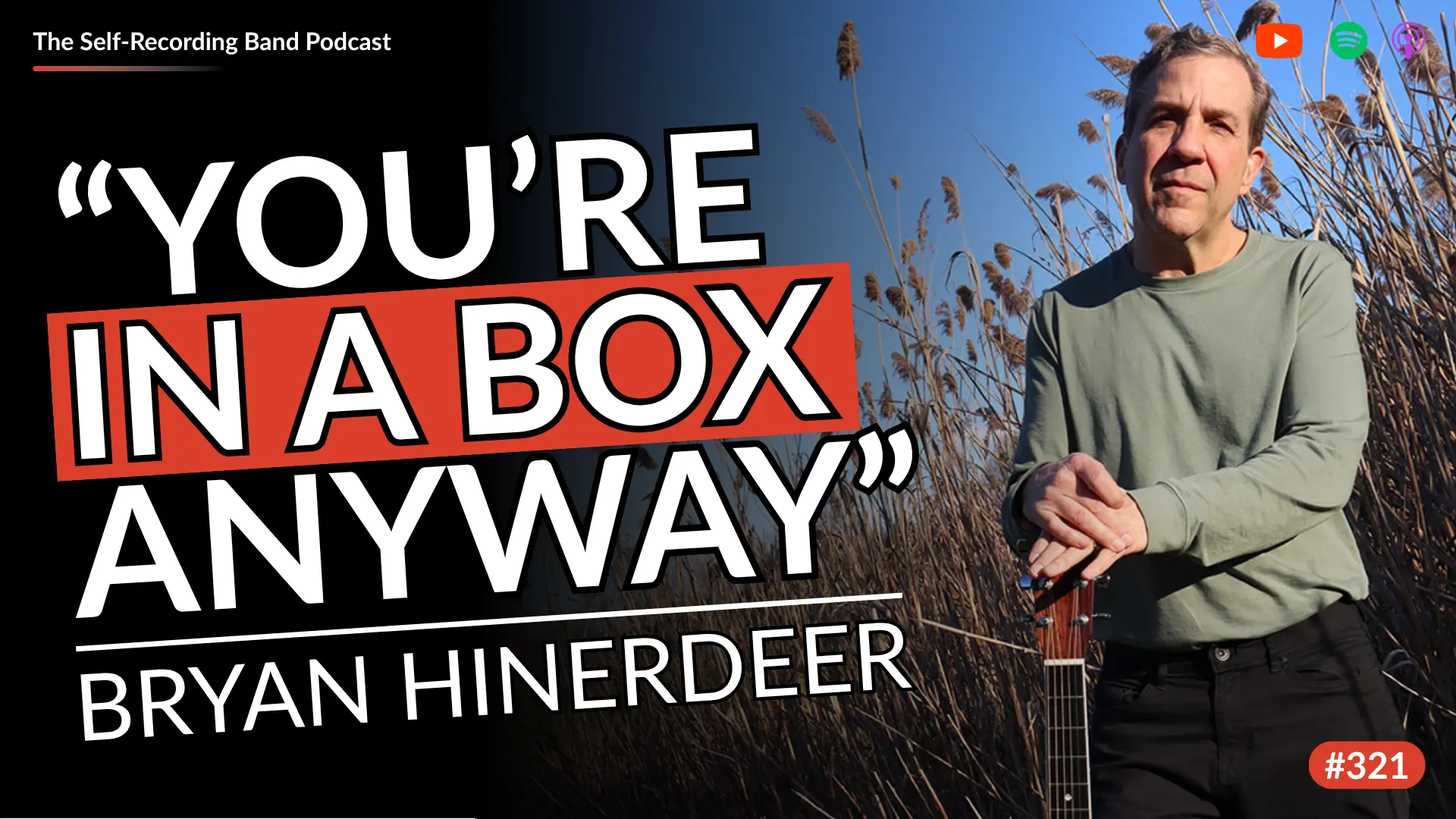
Most musicians think creativity needs freedom.
No rules. No limits.
No one telling you what to make.
But sometimes the opposite is true.
Sometimes the thing that makes you more creative is being told:
- Here’s the genre
- Here’s what the song needs to accomplish
- Here are some references
- Here’s the deadline.
Now make something.
That’s one of the biggest lessons Bryan Hinerdeer has learned through writing music for sync licensing.
More...
You've hit a wall with your audio skills and can't seem to improve your sound, no matter what you do?
See if you are a great fit for The Self-Recording Syndicate!
It is the number one way for DIY producers around the world to get results that they'll be proud of forever.
- Grow your audience with songs that don't sound "demo-y".
- Be taken seriously by your peers, fans and other musicians.
- Make records that sound as good as your favorite songs in your playlist.

Here's how to get there:
Apply for unlimited, personal 1-on-1 coaching (results guaranteed) - This is by far the fastest and best way to achieve your goals. Your gonna be working 1-on-1 with an experienced studio pro until your project is done. On your own songs, from your (home) studio and in your DAW of choice.
Bryan is a songwriter, guitarist, live musician, and longtime member of The Self-Recording Syndicate. Alongside his own music and his band, The Bryan Scott Revival, he’s spent the last few years learning to write and produce music for sync briefs.
And those briefs have become more than potential licensing opportunities.
They’ve become creative exercises.
You’re Already In A Box
Writing to a brief can sound restrictive.
Bryan might receive instructions asking for a specific genre, mood, instrumentation, production style, or reference tracks.
That seems like the opposite of artistic freedom.
But Bryan points out something important:
You’re already working inside a box with your own music.
Your influences, your habits, your favorite chord progressions, the musicians you normally work with, the sounds you instinctively choose...
You just might not realize it.
A different set of constraints can force you outside that familiar box.
And that’s where things get interesting.
Constraints Give You A Problem To Solve
One reason Bryan enjoys sync briefs is that somebody else gives him the assignment.
Instead of sitting down thinking:
“What should I write?”
he can look at a brief and think:
“How do I approach this?”
The brief gives him a target.
That might include:
- a genre
- an emotional purpose
- reference tracks
- instrumentation
- whether vocals are allowed
- production expectations
- licensing requirements
- a deadline
That doesn’t remove creativity.
It just changes where the creativity happens.
Now you need to find an original solution inside those boundaries.
“Sounds Good” Isn’t Enough
One of the biggest lessons Bryan learned from submitting music for sync is that a good song can still be the wrong song.
He would sometimes submit something he thought matched perfectly.
Then the feedback would come back:
Good song. Wrong genre.
Or:
Right genre. But it sounds dated.
That forced him to start listening differently.
Suddenly questions like these mattered:
- Does this reverb make the song sound like it came from the 1980s?
- Do these drums actually belong in this genre?
- Does this arrangement feel contemporary?
- Are the references pointing toward a production style I’m missing?
The feedback wasn’t always easy to interpret.
But that was part of the training.
Your Ears Have To Develop
Bryan was already an experienced musician when he started learning production seriously.
He had played guitar for decades.
He was comfortable playing to a click.
He had performed live.
But recording exposed a different kind of listening.
Early on in our collaboration, we would point out timing issues in his recordings and Bryan sometimes genuinely couldn’t hear what we meant.
Then he would listen again. Eventually he’d hear it.
And over time, he started noticing those things before anyone else pointed them out.
Bryan describes this as the maturing of his ears.
That’s one of the most important skills in recording.
You cannot fix something you cannot hear.
Being A Good Musician And Being A Good Recording Musician Are Different Skills
Playing live gives you some room.
A small timing difference disappears, everything is loud, everyone is reacting to each other, the moment passes.
A recording is different.
You can listen to the same two seconds fifty times.
Suddenly tiny inconsistencies become obvious.
Bryan had to learn not only to play well, but to play well for the recording.
He also learned techniques like comping multiple takes and choosing the best sections instead of endlessly trying to repair weak performances afterward.
And gradually the obvious production problems disappeared.
The Goal Changed From “Is This Good Enough?” To “Did I Interpret The Brief Correctly?”
That’s an important milestone.
Early on, Bryan’s feedback could include production problems, like timing issues, audible editing artefacts, problematic drum tones or drum programming mistakes, mix choices.
Later, those problems became much less common.
He explains that once his production improved, the feedback was more often about whether the music fit the brief rather than whether it sounded professionally produced.
That’s a huge shift.
Once the technical foundation is solid, you can focus on taste, interpretation, emotion, genre, and intent.
That’s where producing becomes much more interesting.
Ready To Transform Your Sound And Workflow?

Apply for professional mentoring and book a free clarity call with Benedikt to see if our programs are a great fit for you!
Drums Were The Hardest Part
Like many self-recording musicians, Bryan found drums especially difficult.
Programming drums sounds easy until you go beyond presets and actually try to make them feel convincing.
You need to understand:
- what a drummer would realistically play
- sample choice and tuning
- choosing and setting up virtual drum mics
- what different drum sounds communicate
- how the kit fits the genre
- velocity and dynamics
- routing and multi-output instruments
- mixing individual drum channels
- how much editing is too much
Bryan initially avoided complicated drum productions and focused on material where simple percussion could work.
Over time, he gradually took on more complex arrangements.
Collaboration Can Solve Problems Faster
One of Bryan’s most interesting sync projects came from a punk brief.
Punk wasn’t his normal world.
So he reached out inside The Self-Recording Syndicate and teamed up with another member, Torsten, who had a punk background and stronger drum programming and production skills.
Bryan brought songwriting and vocals.
Torsten brought complementary production strengths.
The result became Bryan’s first track to get forwarded through the sync submission process.
That experience reinforced something Bryan now strongly believes:
Good collaborators don’t have to be good at the same things you are.
They should bring something you don’t.
Don’t Collaborate With A Copy Of Yourself
Bryan makes a great point near the end of the episode.
If your biggest strength is songwriting, another great songwriter might not solve your biggest problem.
Maybe you need someone who is great at drums, vocals, arrangement, production, mixing, etc... you get the idea.
The most useful collaborators often fill the gaps in your own skill set.
That’s when collaboration becomes more than two people doing the same job.
You start stacking different perspectives and experiences on top of each other.
Modern Doesn’t Mean Generic
Another recurring challenge in Bryan’s sync work has been the word:
contemporary.
What does that even mean?
That question led to discussions about reverb, drum sounds, arrangement, timing, production choices, and how different eras of recorded music have recognizable sonic fingerprints.
A song can be beautifully played and recorded and still feel dated.
Not bad. Just dated.
Bryan has been learning to separate his natural influences from the sound the brief actually requires.
That doesn’t mean abandoning his taste.
It means understanding it well enough that he can choose when to follow it and when to deliberately do something else.
You Can Sound Organic Without Sounding Sloppy
Bryan naturally gravitates toward organic music.
Classic rock, blues, folk, acoustic music.
Records that feel human rather than hyper-polished.
But importantly, he doesn’t use that preference as an excuse for weak production.
He wants the human feel without unnecessary mistakes.
The goal is intention, not perfection.
That balance takes time to learn.
A lot of musicians start loose because they don’t yet hear the problems.
Then they discover editing and go too far.
Everything becomes perfectly aligned, perfectly tuned, perfectly controlled.
Eventually they find their own middle ground.
Tight enough to sound professional, human enough to still feel alive.
Simple Recording Setups Often Win
Bryan also shares his approach to recording acoustic guitar.
He experimented with multiple techniques:
- Stereo pairs.
- Close and room microphones.
- Different positions.
Eventually, he found himself returning to something much simpler:
One condenser microphone positioned in front of the guitar, around the 12th fret area and angled toward the sound hole.
He surrounds himself with portable absorption made from moving blankets to reduce unwanted early reflections.
For one acoustic punk track, he switched to a pencil condenser because he wanted more attack.
The lesson is that there's not one correct microphone setup. It always depends on the song, the player, the sonic vision, the room, the guitar... all of the moving parts.
Bryan experimented enough to understand what different choices do.
Now he can choose intentionally.
Pre-Production Isn’t Optional
When asked about one of his biggest coaching takeaways, Bryan brings up something deceptively simple:
Don’t skip the early stages.
It’s easy to have an idea and immediately hit record.
But Bryan found that planning, demoing, pre-production and thinking through the arrangement first made the whole process better.
At first, those steps feel like they slow you down.
Eventually you realize they save time.
You solve problems while they’re still cheap to solve.
Before you record twenty tracks. Before you edit everything. Before you mix.
Honest Feedback Matters
Bryan also talks about something many self-recording musicians struggle to find:
Useful feedback.
Friends and family often say:
“That sounds great.”
And sometimes that’s nice to hear.
But it doesn’t necessarily help you improve.
Bryan says one thing he values about the coaching is that we don’t simply tell him what he wants to hear.
If something isn’t working, we tell him.
That feedback helps him learn what to listen for the next time.
Eventually you need less feedback because you begin hearing those problems yourself.
That’s the real goal.
Sometimes The Box Is Exactly What You Need
Creative freedom sounds great.
But unlimited options can be paralyzing.
A constraint gives you a starting point. A deadline forces decisions. A reference creates direction. A genre gives you boundaries. A collaborator exposes you to choices you wouldn’t make yourself.
And a brief gives you a problem to solve.
Bryan’s experience with sync licensing is a great example of how limitations can become creative tools.
Because the truth is:
You’re in a box anyway.
The question is whether you’re willing to step into a different one and see what happens.
Listen To The Episode
Watch The Episode
In This Episode
- Why creative constraints can improve songwriting
- How sync licensing briefs work
- Writing music to references without copying
- Learning to interpret vague creative feedback
- Why production choices can make music sound dated
- Developing your ears through repetition and feedback
- Recording tight performances without over-editing
- Why drums are difficult for self-recording musicians
- Programming more convincing drums
- Collaborating with musicians who have complementary strengths
- Bryan’s first sync track to get forwarded
- The difference between playing live and recording
- Why better recording skills improved Bryan’s live performances
- Organic vs polished production
- Making music sound contemporary without making it generic
- Bryan’s acoustic guitar recording technique
- Why simple setups often work best
- The importance of pre-production
- Why honest feedback accelerates improvement
About Bryan Hinerdeer
Bryan Hinerdeer is a songwriter, guitarist, recording musician, and member of The Self-Recording Syndicate.
He performs with The Bryan Scott Revival in the Lancaster, Pennsylvania area and has spent the last few years developing his songwriting and production skills while exploring sync licensing and writing music to briefs.
The Bryan Scott Revival:
https://thebryanscottrevival.com
Spotify / streaming:
Search for The Bryan Scott Revival on your preferred streaming platform.
Want our personal help with your next music project?
If you want to explore the full potential of your creations, learn to listen in a completely different way, and get the production skills to finish songs consistently...
👉 Book a free first coaching session with us
We’ll listen to your music, look at your current situation, create a custom plan for you and figure out if you're a good fit for our coaching inside The Self-Recording Syndicate.
If you are, we can help you make records you're proud of and give you the skills and confidence to do it over and over again.
Recommended Free Downloads:
Standout Mixes – The DIY Musician’s Guide To Exciting Mixes That Connect
Follow And Connect With Us:
Outback Recordings (Benedikt's Mixing Studio and personal website)
Manel's Website
TSRB Instagram
Benedikt's Instagram
Manel's Instagram
If you have any questions, feedback, topic ideas or want to suggest a guest, email us at: podcast@theselfrecordingband.com