
There are ambitious creative projects.
And then there’s deciding to cover every original song ever released by one of Germany’s biggest punk bands.
That’s what music producer Tobi Seitz, aka Samy Braysel, is doing with his Die Erbse project.
After removing duplicate versions and songs that Die Ärzte themselves covered from other artists, Tobi puts the catalogue at roughly 400 songs.
At the time of this conversation, he was approaching cover number 42.
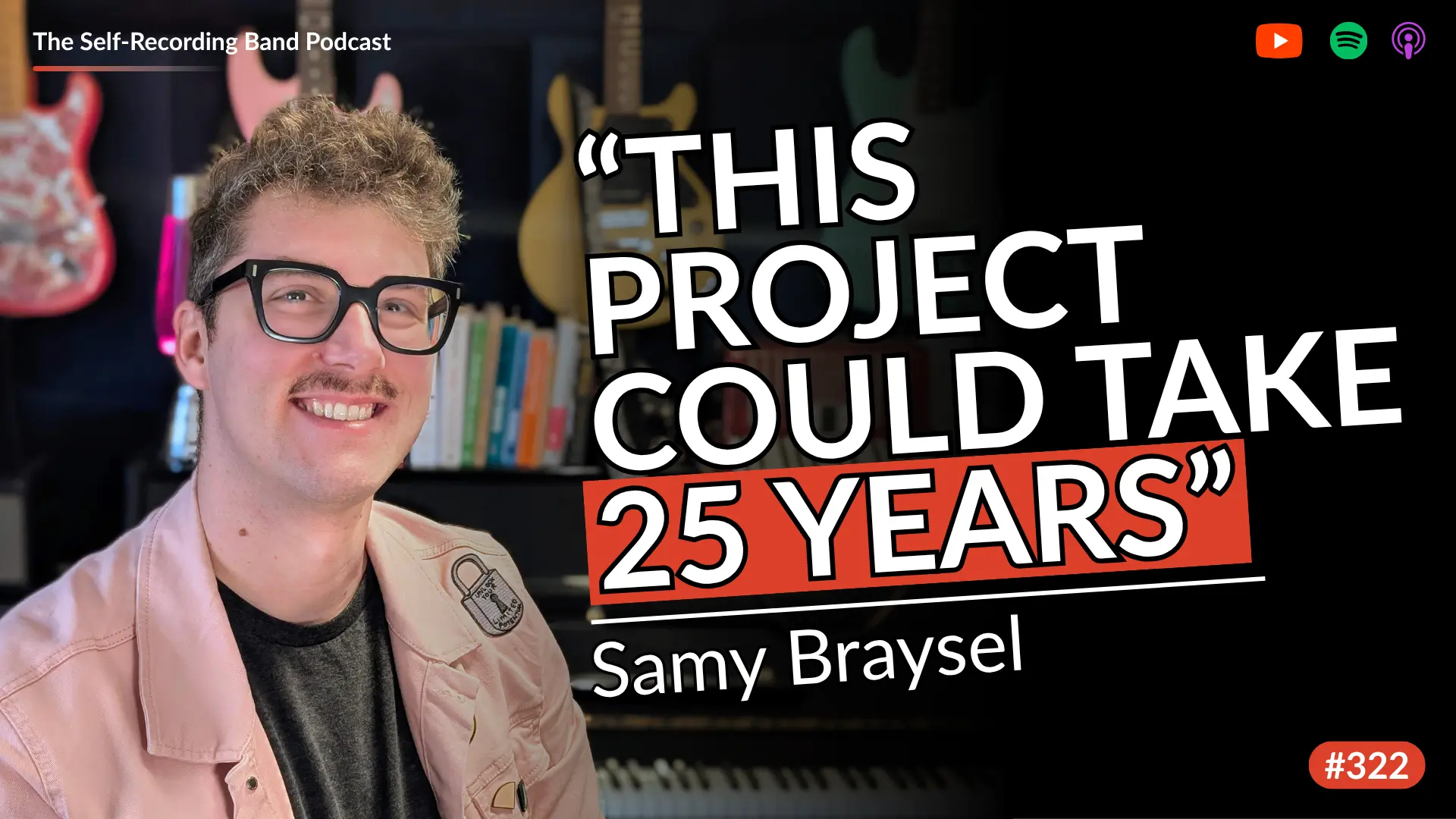
And he knows completing the whole thing could take him 25 years or more.
So why would anybody start something like that?
Tobi’s answer tells you a lot about the way he approaches creativity:
If an idea is insane enough, sometimes you have to start immediately.
Otherwise, you’ll think about it for too long and never do it.
More...
You've hit a wall with your audio skills and can't seem to improve your sound, no matter what you do?
See if you are a great fit for The Self-Recording Syndicate!
It is the number one way for DIY producers around the world to get results that they'll be proud of forever.
- Grow your audience with songs that don't sound "demo-y".
- Be taken seriously by your peers, fans and other musicians.
- Make records that sound as good as your favorite songs in your playlist.

Here's how to get there:
Apply for unlimited, personal 1-on-1 coaching (results guaranteed) - This is by far the fastest and best way to achieve your goals. Your gonna be working 1-on-1 with an experienced studio pro until your project is done. On your own songs, from your (home) studio and in your DAW of choice.
A 25-Year Creative Project
Tobi doesn’t simply run through the songs as quickly as possible.
Sometimes he tries to honor the original and recreate it closely.
Other times, particularly with older songs, he asks what would happen if he transported the song into a more modern production style.
The point is learning what makes the original work and deciding whether to preserve it or reinterpret it.
And after listening to some of these songs for more than 20 years, recreating them has revealed details he had never noticed before.
That was one of his answers in our rapid-fire round:
There is an incredible amount hidden inside songs you think you already know.
That alone makes the project a pretty incredible production exercise.
But Samy Braysel Is Much More Than A Cover Artist
The Die Ärzte project might be the most immediately ridiculous thing on Tobi’s creative résumé.
It definitely isn’t the only thing on it.
He...
- ...writes and releases his own music
- ...plays guitar, bass, drums and other instruments
- ...produces other artists
- ...records and edits full productions
- ...plays in different band projects
- ...teaches guitar and songwriting
- ...repairs and restores guitars
- ...buys and sells instruments
- ...plans to build more guitars from scratch
- ...runs Hitzen Audio, his music production business
And somehow, there’s a philosophy connecting most of it.
Don’t Overthink It
Tobi likes giving himself creative challenges.
For his instrumental project Confusion of ChiffChaff, he experimented with writing and recording music in extremely limited amounts of time.
The idea was roughly:
Three hours to write and record.
Another few hours to mix.
Then release something every other Friday.
The point was output, not perfection.
Tobi calls his philosophy:
“Don’t overthink it.”
He did something similar in January 2026.
Every day, he picked up his guitar and recorded the first idea that came into his fingers.
At first, he expected those to just be riffs.
Then some ideas started turning into bass parts, drums, piano and more developed demos.
And importantly, they didn’t simply disappear into a folder.
He continues to reuse those ideas in songs and other content.
The exercise created raw material.
Unfinished Songs Stay In Your Head
One of Tobi’s older band projects, Ron Jambo, had a song sitting unfinished for roughly a decade.
Everyone had already recorded their parts.
The band had moved on.
But the song was still there.
Eventually, Tobi decided to finish it.
And he describes something that probably sounds familiar to anyone with a hard drive full of unfinished sessions:
Unfinished projects stay in the back of your mind.
They keep reminding you that they’re still there.
Finishing the song gave him closure.
His conclusion is wonderfully simple:
“It’s done. And that’s what matters here.”
90% Might Actually Be Enough
Tobi applies the Pareto principle to making music.
Roughly speaking:
20% of the work often gets you 80% of the result.
And that creates an uncomfortable question.
How much time should you spend chasing the final few percent?
Tobi isn’t arguing that quality doesn’t matter.
His work clearly shows that he cares about quality.
Instead, he asks whether another enormous block of work will actually change the listener’s experience enough to justify it.
Sometimes getting to 90% and releasing the song is a much better decision than spending months chasing an imaginary 100%.
And more often than not, the essence of the song gets lost in an effort to make it "perfect".
His philosophy:
If you’re happy with it, ship it.
How Do You Know When A Song Is Finished?
Manel asks Tobi one of the hardest questions in music production:
How do you know when something is actually good enough?
Tobi has an interesting test.
Imagine somebody tells you:
“This song is great. It’s finished.”
Would you immediately argue with them?
Would there still be something you absolutely need to change because it would noticeably improve the listener’s experience?
If the answer is no, Tobi considers that a strong sign that the song might actually be done.
He also wants the imperfections that remain to feel human.
That’s part of the finished product rather than something that automatically needs fixing.
“I Want It To Sound Like A Human Made It”
That sentence probably sums up Tobi’s production philosophy better than anything else in the episode.
He wants polished records.
He wants good performances.
He wants them to sound professional.
But he doesn’t want them to sound robotic.
Tobi records real instruments and especially enjoys recording acoustic drums. As his technical skills improve, he says one of the things he has to consciously watch is whether the extra polish starts removing the human character he actually wants.
That distinction is important.
Professional doesn’t have to mean perfect.
And human doesn’t have to mean sloppy.
The art is finding the point between the two that fits your music.
Keep The Mistake If It Makes The Record Better
There’s a great little example of this on Tobi’s song “Always Smiling.”
During one vocal take, his voice cracks while reaching the top of his range.
Technically a mistake.
So what did he do?
He kept it.
Because it belongs in the performance and actually feels just right for the part.
That’s a very different mindset from blindly correcting everything simply because the tools exist.
The question becomes:
Does this make the song worse?
Or does it make the performance feel more alive?
The Story Behind “Always Smiling”
“Always Smiling” is the first official release under the Samy Braysel artist name.
And the premise is unusual.
Imagine AI takes over a day job you never particularly liked anyway.
At first glance, you’re supposed to be devastated.
You lost your job.
But another part of you suddenly realizes:
You’re free. At least temporarily.
You can make art, see friends, do the things you weren’t doing while spending your days at a job you didn’t enjoy.
Tobi wrote much of the song really quickly. He describes being at work when the idea arrived and writing down the lyrics in around five minutes, already hearing the melody and knowing the chords despite not having an instrument nearby.
The song is fast, loud, wild and deliberately fun.
The smile isn’t sarcastic.
It’s the brief feeling of liberation before reality eventually catches up again.
Start With The End In Mind
One production habit Tobi has changed is using references much earlier.
For a long time, he didn’t necessarily start a production by deliberately defining influences and reference songs.
Now he does.
And it has helped him develop a much clearer idea of where the song needs to go before recording it.
That matters because many of the most important production decisions happen at the source.
Instrument, performance, arrangement, drum tuning, tone, microphone.
If you don’t know what you’re trying to create until the mix, many important decisions have already been made.
Tobi says the finished result can absolutely deviate from the original plan.
That’s part of creativity.
But having the destination in mind gives you somewhere to start.
Ready To Transform Your Sound And Workflow?

Apply for professional mentoring and book a free clarity call with Benedikt to see if our programs are a great fit for you!
Producing Other Artists Is Different
Tobi also works as a producer for other musicians.
And interestingly, he says producing his own songs is usually easier.
Why?
Because when it’s his music, he knows what he wants.
When it’s someone else’s song, he feels a responsibility to make them shine.
He has to understand what the artist hears in their head, even when they don’t have the vocabulary to explain it.
That might mean someone saying:
“I want this part to go…”
…and making a noise instead of naming an instrument.
Tobi actually enjoys decoding that.
That ability is one of the core skills of producing artists:
You don’t just execute your own ideas.
You learn to understand theirs.
Why He Repairs Guitars Too
As if all the music projects weren’t enough, Tobi also restores and sets up guitars.
But this part has a different purpose for him.
He describes it almost like meditation.
Music production involves a lot of screen time.
Working on a guitar is physical.
Focused.
You can touch the instrument.
Take it apart.
Level and crown the frets.
Restore it.
Set it up properly.
And immediately feel the difference when it’s finished.
He has even attended luthier school and wants to build more instruments from scratch.
You Take The Time
Eventually, I had to ask the obvious question.
How does someone actually have time to do all of this?
His answer isn’t a productivity hack.
There’s no complicated system.
You take the time.
When Tobi was working full time, it meant evenings and weekends.
If it’s 9 PM, you still have an hour from 9 to 10.
You could spend it scrolling.
You could watch another episode of something.
Or you could make music.
His description of the “secret” is even simpler:
Don’t believe your excuses.
Is It Okay To Be A Generalist?
This leads to one of the more interesting philosophical parts of the conversation.
Tobi does a lot of things.
And he knows that means he probably won’t become the absolute best person in the world at every one of them.
He’s okay with that.
He describes himself as more of a generalist — someone who enjoys becoming capable at lots of interconnected things because the learning itself is exciting.
Someone once called him a “Renaissance man.”
Apparently it wasn’t entirely intended as a compliment.
Tobi liked it anyway.
There’s a useful lesson in that.
You don’t have to turn every interest into a competition.
You don’t have to be world-class at every skill you enjoy.
Sometimes being very good at several complementary things lets you create something a narrow specialist couldn’t.
Hitzen Audio
That idea also explains Tobi’s production business, Hitzen Audio.
His goal is to offer artists an end-to-end process.
An artist may start with little more than a melody or an idea.
Tobi can help develop the song, arrange it, record instruments, produce it and bring in additional musicians when the production needs something he can’t provide himself.
His guitar work fits naturally into this too:
If an artist comes in with a badly intonated or poorly set-up guitar, that’s already going to compromise the recording.
So why not solve that problem too?
It’s not about pretending to be the world’s greatest specialist at everything.
It’s about understanding the whole process well enough to help an artist get from an idea to a finished record.
This Project Could Take 25 Years
And that brings us back to the project that started this whole conversation.
Roughly 400 songs.
Around 10% complete.
Potentially decades left.
Is covering every Die Ärzte song the most efficient use of Tobi’s time?
Probably not.
But that’s not really the point.
Sometimes a creative project deserves to exist simply because the idea excites you enough to start.
You might learn things you never expected, become a better player, become a better producer, discover details hiding inside songs you’ve heard for decades, build an audience around something incredibly specific... And maybe, 25 years later, actually finish the damn thing.
But none of that happens unless you start.
Listen To The Episode
Episode 322: He’s Covering The Entire 400-Song Catalogue Of One Band - Samy Braysel
Watch or listen on YouTube, Spotify, Apple Podcasts, or your preferred podcast app.
Watch The Episode
In This Episode
- Why Samy decided to cover every original Die Ärzte song
- Why completing the project could take more than 25 years
- Recreating songs vs reinventing them
- What covering familiar songs teaches you about production
- Creative challenges that prevent overthinking
- Writing and recording quickly
- Why unfinished projects stay in your head
- Knowing when 90% is enough
- How Samy decides when a song is finished
- Keeping human imperfections in polished records
- Recording real drums
- The mistake he deliberately kept in “Always Smiling”
- Writing songs from sudden bursts of inspiration
- Using references before recording
- Producing your own music vs producing other artists
- Translating an artist’s vague idea into a production
- Restoring and building guitars
- How he finds time for so many projects
- Why being a generalist isn’t necessarily a weakness
- Building Hitzen Audio as an end-to-end music production business
About Samy Braysel
Tobi Seitz, aka Samy Braysel, is a German musician, songwriter, multi-instrumentalist and producer.
Alongside his original music, he runs the Die Erbse YouTube project, where he is attempting to cover the roughly 400 original songs in Die Ärzte’s catalogue. He also produces other artists, teaches guitar and songwriting, restores instruments, and runs Hitzen Audio in Lower Bavaria.
Samy Braysel:
Die Erbse:
https://www.youtube.com/@Die_Erbse
Hitzen Audio:
Instagram:
https://www.instagram.com/hitzen.audio/
TikTok:
https://www.tiktok.com/@hitzenaudio
Confusion of ChiffChaff:
https://open.spotify.com/intl-de/album/4A4IYUKMvLEhES3ZzIFyYw
Walls (produced by Samy Braysel):
https://open.spotify.com/intl-de/track/0V4WGClbt12B2TwwM0lMhj
Tuxedo Torpedo:
https://open.spotify.com/intl-de/track/5WTQ2lAyLR5IPt0QGd3bNQ
Always Smiling:
https://samybraysel.com/#presave
Want our personal help with your next RECORDING project?
If you want to learn to listen in a completely different way, and get the production skills to finish songs consistently...
👉 Book a free first coaching session with us:
theselfrecordingband.com
We’ll listen to your music, look at your current situation, create a custom plan for you and figure out if you're a good fit for our coaching inside The Self-Recording Syndicate.
If you are, we can help you make records you're truly proud of and give you the skills and confidence to do it over and over again.
Recommended Free Downloads:
Standout Mixes – The DIY Musician’s Guide To Exciting Mixes That Connect
Follow And Connect With Us:
Outback Recordings (Benedikt's Mixing Studio and personal website)
Manel's Website
TSRB Instagram
Benedikt's Instagram
Manel's Instagram
If you have any questions, feedback, topic ideas or want to suggest a guest, email us at: podcast@theselfrecordingband.com