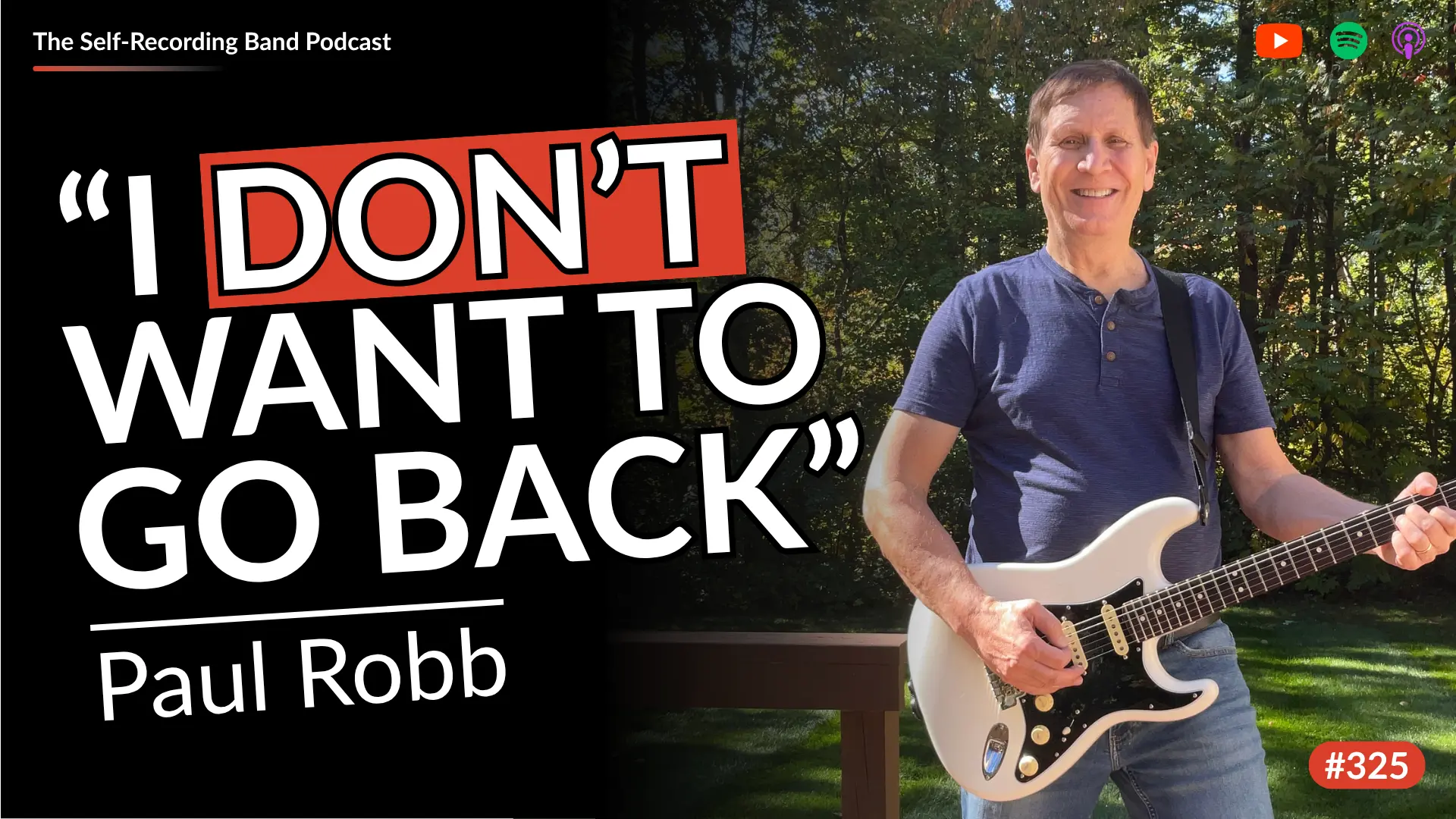
After years away from serious recording, Paul Robb returned to songwriting, learned modern production from the ground up and started releasing music he’s genuinely proud of. His story is a reminder that even with a lot of experience, your best work doesn’t have to be behind you.
More...
You've hit a wall with your audio skills and can't seem to improve your sound, no matter what you do?
See if you are a great fit for The Self-Recording Syndicate!
It is the number one way for DIY producers around the world to get results that they'll be proud of forever.
- Grow your audience with songs that don't sound "demo-y".
- Be taken seriously by your peers, fans and other musicians.
- Make records that sound as good as your favorite songs in your playlist.

Here's how to get there:
Apply for unlimited, personal 1-on-1 coaching (results guaranteed) - This is by far the fastest and best way to achieve your goals. Your gonna be working 1-on-1 with an experienced studio pro until your project is done. On your own songs, from your (home) studio and in your DAW of choice.
Why Your Best Music Might Still Be Ahead Of You
There’s a moment near the end of my conversation with Paul Robb where I ask him a simple question:
If you could live in any decade for a year, which one would you choose?
Paul has plenty of decades to pick from.
He played guitar in rock bands when that meant four sets in smoky bars, learning songs by ear because there was no YouTube tutorial waiting for you, and going to see artists like Ozzy Osbourne, Tom Petty, Journey and Cheap Trick.
But his answer surprised me.
He wouldn’t go back.
“I love looking back, but I don’t wanna go back.”
He loves the memories.
But he’s happy making music now.
And that probably captures Paul’s story better than anything else we talked about.
Your Musical Past Doesn’t Have To Be Your Peak
Paul started playing guitar at 19.
He played in bands, sang, wrote songs and spent years immersed in music.
Then life changed.
Career. Family. Other priorities.
For quite a while, music became something he mostly did with an acoustic guitar for himself.
Eventually he started playing live again with a friend, and that reignited something.
The desire to write.
To record.
To make finished music again.
But the recording world he returned to looked very different from the one he had left.
“I Don’t Know If I Want To Put My Head Into That”
Paul had experimented with four-track machines and early MIDI setups years earlier.
But while he was away from recording, computers and DAWs completely transformed music production.
And when he looked at modern recording software again, his reaction was basically:
This looks like a lot.
So for years, he stayed away from it.
Eventually GarageBand gave him an easier way back in.
Then came other DAWs, a MacBook, Logic Pro, modern plugins, virtual instruments, editing and all the other tools that now make up a home recording setup.
The important part is that Paul learned the system one piece at a time.
The Moment It Changed
One of Paul’s first major projects was a song called “Taggin’ Along.”
He programmed the drums and bass.
He played the guitars.
He sang the lead and background vocals.
And while making it, he repeatedly wondered whether he could actually pull this off.
Then the song came together.
I (Benedikt - Outback Recordings) mixed it.
Paul played it for his wife.
And she told him:
“My gosh, that’s really good.”
That moment mattered.
After years of never being able to get his recordings to the level he wanted, he finally had something that sounded like a real finished record.
Paul describes it as the moment he started thinking:
“I can do it.”
That confidence doesn’t come from watching another tutorial.
It comes from finishing something.
Progress Doesn’t Have To Be Fast
Paul is also refreshingly open about the fact that his process hasn’t always been fast.
He procrastinates, he gets distracted.
A technical problem that looks like a ten-minute fix sometimes eats the entire session.
Life gets in the way.
Sound familiar?
But his solution isn’t some magical productivity system.
He works in small chunks.
Do what you can today, come back tomorrow.
Keep moving.
And most importantly:
Never stop trying.
Paul talks about learning to treat the obstacles themselves as opportunities to improve. Looking back at his time in The Self-Recording Syndicate, he can clearly see how much knowledge and skill he has accumulated, even if the path took longer than it might for somebody else.
There’s something important in that.
You’re not behind because your record took six months instead of six weeks.
The question is whether you’re still moving.
Self-Recording Doesn’t Mean Doing Everything Yourself
Another major shift happened when Paul realized:
He didn’t have to personally do every job on every record.
That sounds obvious.
But a lot of self-recording musicians quietly turn DIY into a rule.
If it’s my record, I should write it, play every instrument, record it, edit it, mix it and master it.
Why?
Paul increasingly approaches his songs more like a producer.
He decides what he wants the song to become.
Then he figures out the best way to get there.
Sometimes he plays the guitar himself, sometimes a session musician can execute something better.
Sometimes he programs parts, sometimes he collaborates.
He gets outside help with editing and production.
And for his finished releases, he has chosen to let me handle the mix so he can spend more of his time doing the thing he cares about most:
Writing and producing songs.
That isn’t giving up creative control.
It’s producing. Part of the producer's job has always been building the best team for the project.
Use The Tool. Don’t Let The Tool Replace You.
Paul is also fascinated by new technology.
Logic’s Session Players, virtual instruments, songwriting tools, and yes... AI.
And our conversation gets into an important distinction.
Paul doesn’t use those tools because he wants them to make music instead of him.
He uses them to explore.
He might record a rough guitar-and-vocal idea, experiment with different directions, listen to what something suggests, then go back and build his own version from there.
His simple principle for AI also applies to almost every production tool:
If it’s doing your work for you, you may be cheating yourself.
If it helps you become better, smarter or more creative, that’s a different thing.
You don’t have to agree with every tool Paul uses.
That isn’t really the point.
The useful question is:
Does this tool help you create better music and does it help you get better at it, or does it replace the part of the process you actually wanted to learn because you love it?
Sometimes The Fastest Way To Learn Is With Other People
Paul has also been one of the most consistent people on our Self-Recording Syndicate group calls.
And something he says in the episode sums up why those calls can be so useful:
Sometimes he joins without having a question.
Then somebody else asks something and he realizes:
“I guess I had a question. I didn’t know I had a question.”
That happens constantly.
Someone shows their session, someone explains a problem, someone else demonstrates a solution.
And suddenly you’ve learned something you didn’t even know you needed to learn.
Paul says he never leaves one of those calls without taking something useful away.
That’s also why collaboration can accelerate this whole process so much.
You only have your own experience.
A community gives you everybody else’s too.
Ready To Transform Your Sound And Workflow?

Apply for professional mentoring and book a free clarity call with Benedikt to see if our programs are a great fit for you!
Write The Song That Sounds Like You
One of my favorite parts of Paul’s current journey is that he isn’t trying to reproduce his musical past.
He still loves the guitar-driven music he grew up with.
And some of that inevitably comes through in his songs.
But he also listens to a huge amount of contemporary music and deliberately explores different styles, arrangements and songwriting approaches.
And every time he tries to sound like something else?
It still comes out sounding like Paul.
Which is probably exactly what should happen.
His focus now is less about copying a genre and more about questions like:
Does the chord progression make him feel something?
Does the melody work?
Can he sing it convincingly?
Are the lyrics actually saying what he wants them to say?
Paul says lyric writing in particular has become one of his strengths because he now spends much more time refining lines instead of accepting the first thing that works.
Your Best Song May Be The Next One
Paul currently has released songs including “Taggin’ Along” and “California,” with more material in progress.
When he played one of those upcoming songs for his grandson, the response was:
“I think that’s your best song yet.”
That’s a pretty good place to be after decades of making music.
Not:
My best days were back then.
But:
The next one might be even better.
You don’t need to become the person you were 20 years ago.
You don’t need to wish you had started sooner.
You don’t need to master everything before you begin.
You need to keep writing, keep recording, keep learning, keep finishing things.
Because your best music might still be ahead of you.
Listen / Watch
Why Your Best Music Might Still Be Ahead Of You - Paul Robb
Listen To Paul Robb / Small Town
Taggin’ Along:
https://open.spotify.com/track/0Xvam5v2P3dWyVJNIG8VDp?si=83c0c599590a4229
California:
https://open.spotify.com/track/6sd92MMK2WCDhd4bIdmEl6?si=48d16e88312642c2
Want To Make Your Own Record?
If you’re writing and recording your own music but you’re still struggling to turn those songs into records you’re genuinely proud of, that’s exactly what we help self-recording artists do.
Apply for a free first coaching call →
https://go.theselfrecordingband.com/coaching
Recommended Free Downloads:
Standout Mixes – The DIY Musician’s Guide To Exciting Mixes That Connect
Follow And Connect With Us:
Outback Recordings (Benedikt's Mixing Studio and personal website)
Manel's Website
TSRB Instagram
Benedikt's Instagram
Manel's Instagram
If you have any questions, feedback, topic ideas or want to suggest a guest, email us at: podcast@theselfrecordingband.com