
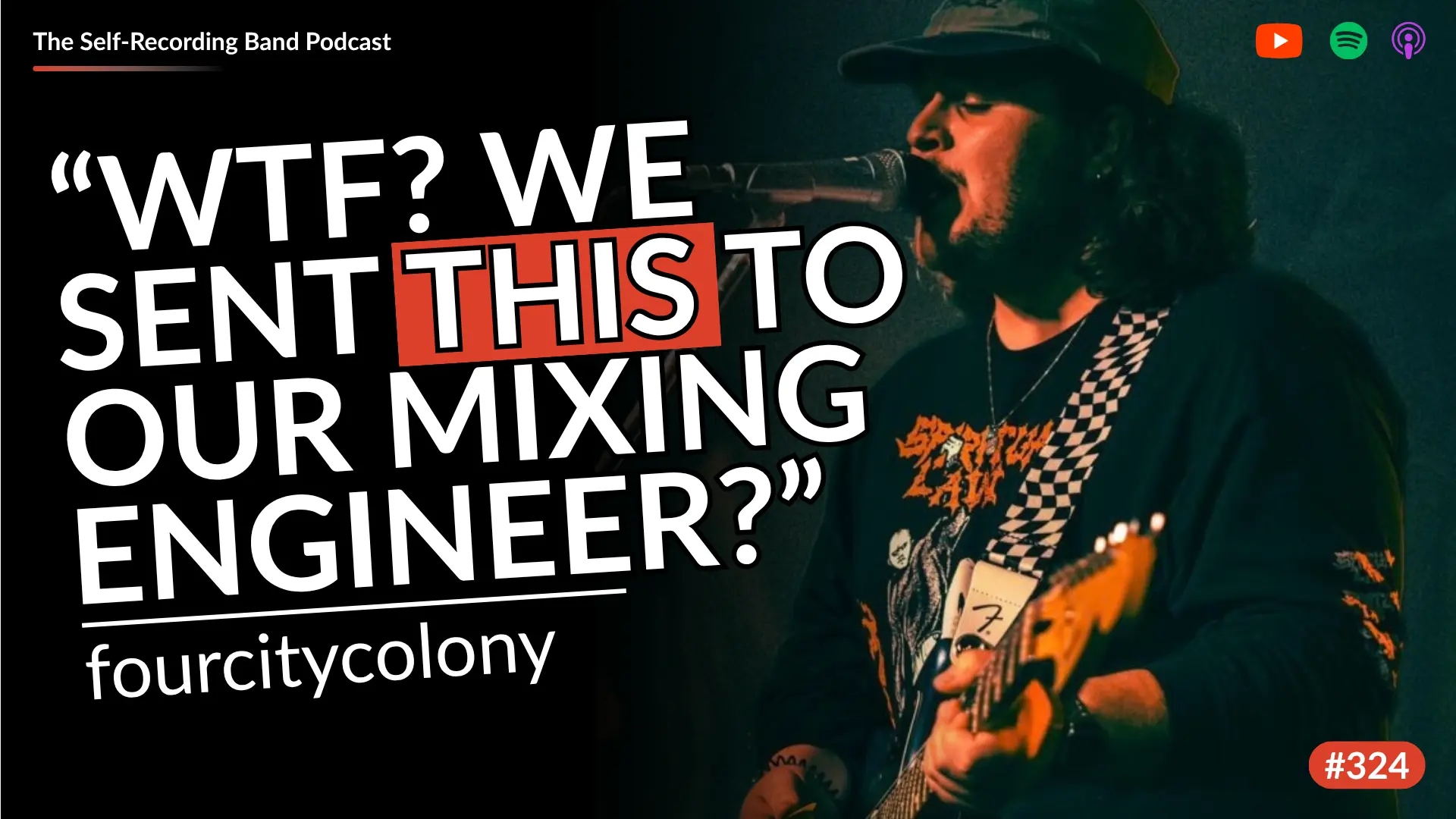
Stefan Thoms of fourcitycolony joins us to talk about self-recording a band, capturing live energy, learning from recording mistakes, working with outside mixers and getting noticeably better with every record.
More...
You've hit a wall with your audio skills and can't seem to improve your sound, no matter what you do?
See if you are a great fit for The Self-Recording Syndicate!
It is the number one way for DIY producers around the world to get results that they'll be proud of forever.
- Grow your audience with songs that don't sound "demo-y".
- Be taken seriously by your peers, fans and other musicians.
- Make records that sound as good as your favorite songs in your playlist.

Here's how to get there:
Apply for unlimited, personal 1-on-1 coaching (results guaranteed) - This is by far the fastest and best way to achieve your goals. Your gonna be working 1-on-1 with an experienced studio pro until your project is done. On your own songs, from your (home) studio and in your DAW of choice.
Capturing The Band vs. Producing The Band
There’s a funny moment in this episode where Stefan Thoms and I (Benedikt) talk about one of fourcitycolony’s previous records.
The band had just compared their older recordings to what they’re capable of recording now.
Their reaction?
“What the fuck? We sent this to Benedikt?”
And I think that’s a wonderful problem to have.
Because if you can listen back to something you made a few years ago and immediately hear everything you would do differently today, you got better.
That’s what making records is supposed to do to you.
You Don’t Have To Do Everything Yourself
Fourcitycolony have settled into an approach that makes a lot of sense for self-recording bands.
They record much of their music themselves.
But they don’t treat “DIY” as a rule that says every single part of the process has to happen without outside help.
They’ve worked with professional engineers for mixing and mastering, asked for feedback while recording and used outside expertise where it could improve the final result.
That’s an important distinction.
Self-recording doesn’t have to mean doing everything alone.
The real question is:
What parts of making the record do you want to own, and where would another person make the result better?
Capturing The Band vs. Producing The Band
One of the most interesting questions in this conversation is what a record should actually represent.
Should it simply document what your band sounds like live?
Or should the studio be its own creative environment where you can build something that wouldn’t be possible on stage?
How much do influences from other bands matter? What's the vision for the project? Should you try to recreate sounds from a reference?
For fourcitycolony, the live band is the starting point.
They already know what their guitars should feel like together. They know their songs, their dynamics and their general sound.
So the goal was largely to bring that band into the recording rather than reinvent everything in the studio.
But they’ve also become less strict about reproducing everything exactly.
On the new record, they added guitar parts and little production elements they won’t necessarily reproduce live.
And that’s okay.
A record and a live show are different experiences.
Trying to force one to behave exactly like the other can unnecessarily limit both.
Sometimes You Really Do Need To Re-Record It
Their previous recording also came with a painful lesson:
Tuning matters.
A technical issue with the bridge of a guitar meant some of the recorded guitars simply weren’t stable enough.
By the time I heard the production, the record was already pretty far along.
And I essentially had to tell them:
Those guitars need to be recorded again.
So they did.
No excuses. No trying to rescue something that fundamentally wasn’t right.
They changed the guitar setup and recorded the parts again.
That willingness is probably more important than the specific technical lesson.
Because one of the biggest differences between bands that consistently improve and bands that stay stuck is their ability to hear:
This isn’t good enough yet. We need to fix it.
Without turning that realization into an ego problem.
Ready To Transform Your Sound And Workflow?

Apply for professional mentoring and book a free clarity call with Benedikt to see if our programs are a great fit for you!
Change The Environment When The Environment Is The Problem
For the current record, they also changed the way they tracked drums.
Instead of forcing the drums into their usual recording space, they booked a larger, good-sounding room at the Volksmusikakademie Freyung and brought their own recording setup there.
That’s something more self-recording bands should consider.
You don’t necessarily need to book a traditional studio for the entire production.
Maybe your guitars sound great at home.
Maybe vocals work perfectly in your own room.
But if your drum room sounds bad, go somewhere else for the drums.
Rent a rehearsal room, studio live room, hall or other suitable space for a day or weekend.
A hybrid approach lets you spend money where it actually makes a difference.
Let Your Mixer Help Before The Mix
fourcitycolony also worked with Benedikt at Outback Recordings, as well as Sören and Tom at Lime Tree Studios while they were still recording.
They sent test recordings, got feedback on microphone placement and experimented before committing to the final drum recordings.
That’s another big lesson.
If someone is eventually going to mix your record, you don’t necessarily have to wait until everything is finished before involving them.
A few minutes of useful feedback before recording eight songs can save an enormous amount of work later.
The Hard Part: Knowing When It’s Good Enough
But doing everything yourself creates another problem.
There’s no studio clock.
Nobody is standing behind you saying:
“That take is good. Move on.”
And Stefan identifies that as one of the hardest parts of making a record yourself.
You need enough patience not to rush.
But you also need to know when another take isn’t actually making anything better.
Their strategy evolved into something practical:
Set the quality bar early.
Don’t leave all the difficult material until the end.
And if something simply isn’t working late at night, stop and try again tomorrow.
That sounds simple.
It isn’t.
Learning to judge good enough is one of the core skills of self-producing.
Why Another Set Of Ears Still Matters
There’s another reason fourcitycolony continue handing their recordings to someone else for mixing.
Perspective.
The band may have rehearsed a song 50 or 100 times.
They know every weird note, every phrasing choice and every imperfection.
Eventually those things stop sounding unusual.
An outside mixer hears the song without that history.
And sometimes their interpretation exposes things the band simply stopped noticing.
Stefan gives a particularly interesting example with vocal pitch correction.
He doesn’t necessarily want the finished vocals heavily corrected.
But hearing what someone else chooses to correct can reveal notes or transitions that the band had completely normalized.
Then Stefan can decide:
Was that imperfection intentional?
Does he like it?
Or should he actually sing it again?
That’s what good outside feedback can do.
It doesn’t remove your decisions.
It gives you better information for making them.
Your Next Record Should Be Better
The larger lesson from fourcitycolony’s story isn’t that there’s one correct way to make a DIY record.
Quite the opposite.
Their process keeps changing.
They changed guitars.
Changed recording spaces.
Changed session lengths.
Worked with different engineers.
Improved their technical recording skills.
Experimented with production elements they previously wouldn’t have used.
And now they can listen to their older recordings and immediately hear how far they’ve come.
That’s the goal.
You don’t need to know everything before you make the record.
You need to make the record, learn from it, and make the next one better.
Watch Or LISTEN To The Episode
Episode 324: Capturing The Band vs. Producing The Band - And Getting Better With Every Record | fourcitycolony
About fourcitycolony
fourcitycolony are an emo/punk band from Zwiesel, Germany. Stefan Thoms sings and plays guitar, and the band have increasingly taken control of their own recording process while collaborating with outside engineers for mixing, mastering and production feedback.
Some songs mentioned in the episode include “Smile,” “Four Missed Calls,” “Hate To See You Happy” and “Separate Ways.” We highly recommend you check those out!
fourcitycolony:
Instagram: https://www.instagram.com/fourcitycolony
Tour Dates, Socials & Music Streaming Apps: https://linktr.ee/fourcitycolony
Also mentioned:
I Wish I Could Stay Records: https://www.instagram.com/iwishicouldstay.ka
Krachige Platten: https://www.instagram.com/krachigeplatten
Outback Recordings / Benedikt Hain: https://benedikthain.com
Lime Tree Studios: https://www.limetreestudios.de
Volksmusikakademie: https://www.volksmusikakademie.de/einblicke/raeume
Poschinger Villa: https://www.instagram.com/poschingervilla
Want to make better-sounding records yourself without having to figure everything out alone?
👉 Click here to book a free first coaching session with us
We’ll listen to your music, look at your current situation, create a custom plan for you and figure out if you're a good fit for our coaching inside The Self-Recording Syndicate, or for any other kind of collaboration.
If you are, we can help you make records you're truly proud of and give you the skills and confidence to do it over and over again.
Recommended Free Downloads:
Standout Mixes – The DIY Musician’s Guide To Exciting Mixes That Connect
Follow And Connect With Us:
Outback Recordings (Benedikt's Mixing Studio and personal website)
Manel's Website
TSRB Instagram
Benedikt's Instagram
Manel's Instagram
If you have any questions, feedback, topic ideas or want to suggest a guest, email us at: podcast@theselfrecordingband.com