
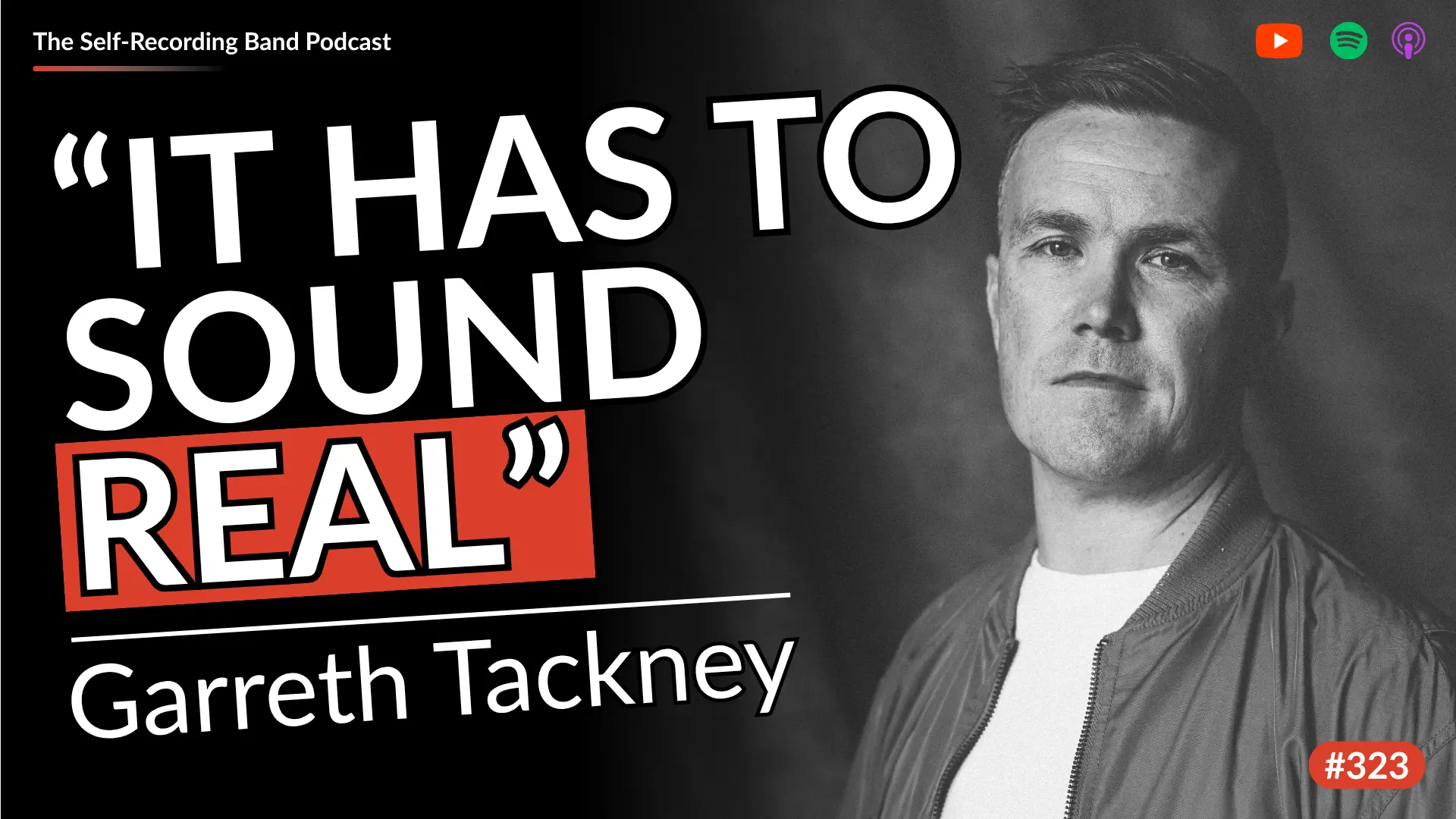
Producer and engineer Garreth Tackney wants records to sound polished without feeling manufactured. We talk about real drums, amps, room sound, imperfections, modern production tools and the decisions that make music feel alive.
More...
You've hit a wall with your audio skills and can't seem to improve your sound, no matter what you do?
See if you are a great fit for The Self-Recording Syndicate!
It is the number one way for DIY producers around the world to get results that they'll be proud of forever.
- Grow your audience with songs that don't sound "demo-y".
- Be taken seriously by your peers, fans and other musicians.
- Make records that sound as good as your favorite songs in your playlist.

Here's how to get there:
Apply for unlimited, personal 1-on-1 coaching (results guaranteed) - This is by far the fastest and best way to achieve your goals. Your gonna be working 1-on-1 with an experienced studio pro until your project is done. On your own songs, from your (home) studio and in your DAW of choice.
What It Takes To Make A Record Feel Alive
A record can be clean, punchy, wide and technically impressive...
…and still somehow feel dead.
That tension sits at the center of producer and engineer Garreth Tackney’s approach to making music.
His philosophy is pretty simple:
“It has to sound real.”
Garreth isn’t against modern production. Quite the opposite. He wants clarity, impact and a finished record that holds up against modern releases.
But he doesn’t want those things at the expense of the people making the music.
For him, a great production should still feel like musicians playing instruments, interacting with a room and putting something human into the speakers.
Real Doesn’t Mean Lo-Fi
There’s an important distinction here.
Making something feel real doesn’t mean deliberately making it rough, amateurish or badly recorded.
Garreth still wants the punch and clarity of a modern record.
The challenge is getting that polish without removing the character underneath it.
That can mean making very different decisions depending on the song.
Sometimes the right move is editing something tightly.
Sometimes it’s leaving it alone.
Sometimes it’s using a sample.
Sometimes it’s allowing the sound of the actual drum kit and room to do more of the work.
The goal is to make the record feel right, not follow a rule.
Drums Have To Feel Like Drums
Drums are one of the clearest examples.
Garreth doesn’t want a kit to feel like a collection of isolated sounds assembled inside a computer.
He wants the listener to get the impression of standing in front of an actual drum kit.
That doesn’t mean samples are forbidden. Garreth uses modern tools when they help.
But the end result still needs the size, movement and energy of a real performance.
One moment from the episode illustrates this perfectly.
While working on a drum mix, Garreth was missing something. After feedback from Benedikt on the room microphones, he pushed and compressed them harder.
Suddenly, as he puts it, “the room was alive.”
That small change gave him the sense of being in the room with the drummer that he had been looking for.
Real Amps, Modern Flexibility
Garreth approaches guitars in a similar way.
His default preference is a real amplifier, cabinet and microphones.
But he isn’t dogmatic about it.
He’ll keep a DI so the performance can be reamped later. And if an amp simulator ends up being the best choice for the record, that’s fine too.
The philosophy is not black and white, like analog good, digital bad.
It’s:
Does it sound right for this song?
That distinction matters.
Modern tools give us an incredible amount of flexibility. The skill is knowing when that flexibility improves the record and when it starts pulling you away from the sound you actually wanted.
Not Everything Needs To Be Fixed
Vocals are another good example.
You can spend hours removing breaths, tightening timing and cleaning every tiny detail.
Sometimes that’s exactly what a song needs.
But sometimes those breaths and tiny irregularities are part of what makes the performance feel like a person singing rather than a perfectly edited vocal file.
Garreth often prefers to keep those natural details when they add something to the performance.
And sometimes the “mistake” is even more obvious.
The Guitar Sound That Was Technically Wrong
On one recording, Garreth discovered that a guitar take had a phase problem between microphones.
Normally, you’d fix it.
Except there was one problem:
They liked the broken version better.
The strange phase relationship created a scooped, unusual guitar tone that worked for the song.
So they kept it.
Garreth calls it a “happy accident.”
That’s an important production lesson:
Learning the technical rules matters.
And so does understanding phase, or knowing how to fix problems.
But the point of learning those things isn’t to blindly correct everything until every meter says you’re right.
It’s to understand what you’re hearing well enough to make an intentional decision.
Ready To Transform Your Sound And Workflow?

Apply for professional mentoring and book a free clarity call with Benedikt to see if our programs are a great fit for you!
Technique Matters More Than More Gear
That idea connects to another major shift Garreth describes in the conversation.
When he first started working with us, he had plenty of good equipment and was happy to talk through all the gear he owned.
Over time, though, one of his biggest realizations was that the equipment itself wasn’t the thing making the largest difference.
“It’s not about the gear.”
Better methods, better recording techniques and better decision-making mattered much more.
For Garreth, that was a genuine eye-opener.
Hearing More Changes Everything
Garreth already had years of experience when he joined The Self-Recording Syndicate.
But the more records he made, the more feedback he got and the more hours he put in, the more his ears changed.
Near the end of the conversation, we ask him what he hears differently now compared with two years ago.
His answer:
“Everything. I hear everything different now.”
That might ultimately be the biggest part of becoming a better producer.
Not learning one secret technique.
Not finding the perfect plugin.
But slowly developing the ability to hear what the song needs, recognize what’s getting in the way, and know when something is already working.
Professional Doesn’t Have To Mean Manufactured
That’s really the thread running through this entire conversation.
Garreth wants records that are:
- clear
- impactful
- intentional
- professionally produced
…but still sound like music made by people.
That can mean room microphones instead of more samples.
A real cabinet instead of an amp sim.
Leaving a breath in.
Keeping an imperfect sound.
Or using every modern tool available because, in that particular moment, it makes the song better.
There isn’t one recipe.
There’s just the question Garreth keeps coming back to:
Does it still feel real?
Watch Or LISTEN To The Episode
Episode 323: What It Takes To Make A Record Feel Alive - Garreth Tackney
Watch or listen on YouTube, Spotify, Apple Podcasts, or your preferred podcast app.
About Garreth Tackney
Garreth Tackney is an Irish musician, producer and recording/mixing engineer behind Devilla Sounds.
He works with artists across rock and related genres, helping turn demos into finished productions.
Garreth is also a member of The Self-Recording Syndicate and has spent the last several years continually refining his recording, production and mixing skills while balancing music with a regular job and family life.
Garreth / Devilla Sounds:
Website: https://devillasounds.com/
Instagram: https://www.instagram.com/devillasounds/
Music / production portfolio: https://devillasounds.com/
Want to make your own recordings sound professional without losing what makes your music yours?
If you want to learn to hear things completely differently, like Garreth did...
👉 Click here to book a free first coaching session with us
We’ll listen to your music, look at your current situation, create a custom plan for you and figure out if you're a good fit for our coaching inside The Self-Recording Syndicate.
If you are, we can help you make records you're truly proud of and give you the skills and confidence to do it over and over again.
Recommended Free Downloads:
Standout Mixes – The DIY Musician’s Guide To Exciting Mixes That Connect
Follow And Connect With Us:
Outback Recordings (Benedikt's Mixing Studio and personal website)
Manel's Website
TSRB Instagram
Benedikt's Instagram
Manel's Instagram
If you have any questions, feedback, topic ideas or want to suggest a guest, email us at: podcast@theselfrecordingband.com