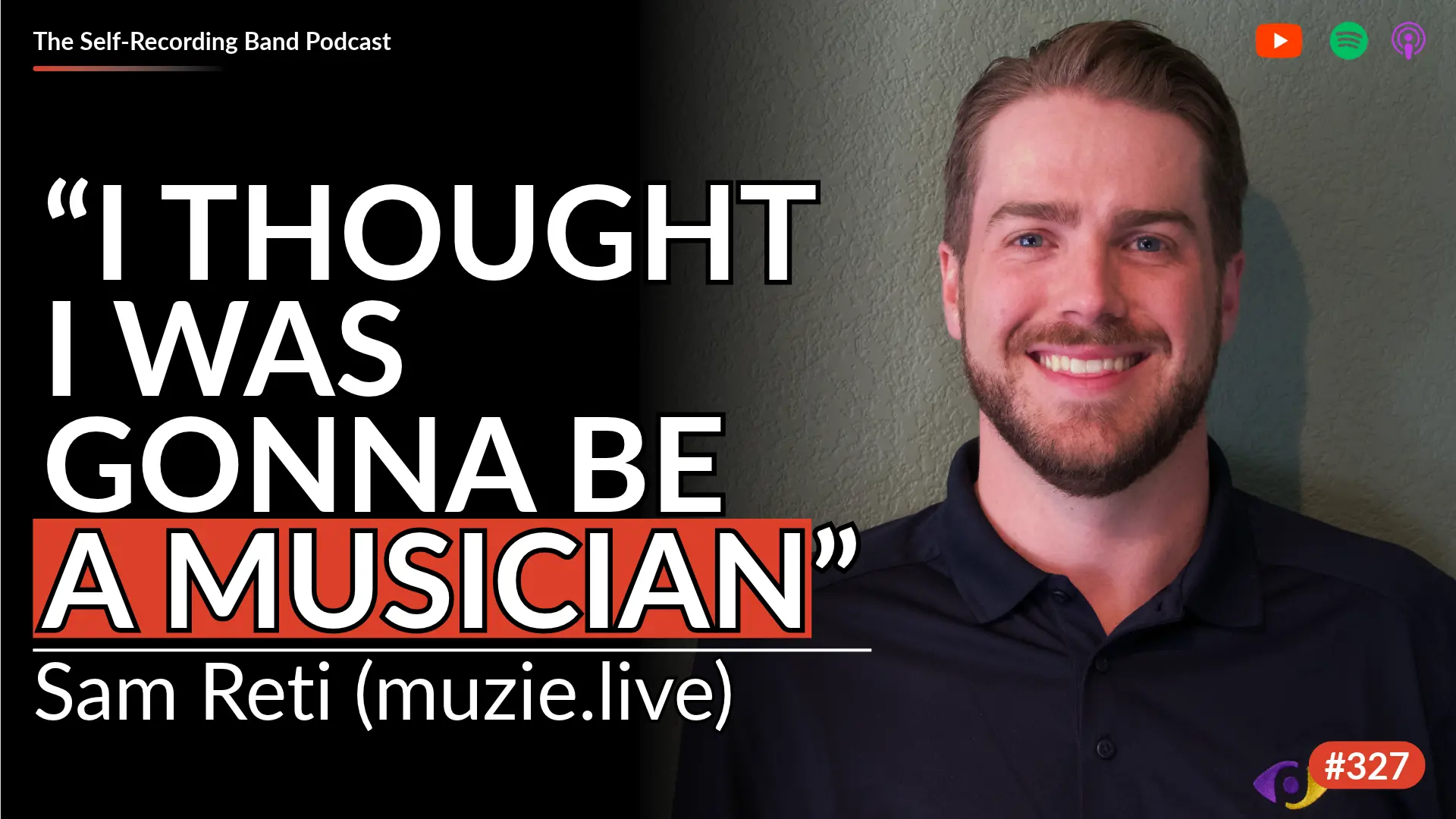
Sam Reti expected to make his living as a musician. Instead, the progressive-metal guitarist ended up building Muzie and solving one of the biggest problems musicians face when trying to teach, rehearse and collaborate online.
More...
You've hit a wall with your audio skills and can't seem to improve your sound, no matter what you do?
See if you are a great fit for The Self-Recording Syndicate!
It is the number one way for DIY producers around the world to get results that they'll be proud of forever.
- Grow your audience with songs that don't sound "demo-y".
- Be taken seriously by your peers, fans and other musicians.
- Make records that sound as good as your favorite songs in your playlist.

Here's how to get there:
Apply for unlimited, personal 1-on-1 coaching (results guaranteed) - This is by far the fastest and best way to achieve your goals. Your gonna be working 1-on-1 with an experienced studio pro until your project is done. On your own songs, from your (home) studio and in your DAW of choice.
Sam Reti thought he was going to be a musician.
And for a while, everything seemed to be moving in exactly that direction.
He studied at Berklee College of Music, played progressive metal, recorded bands, toured, released records and spent hours every day practising guitar.
Then his career took a completely different route.
Today, Sam runs Muzie, a platform built for music teachers, students and musicians who need something that conventional video-call software wasn’t really designed to do:
Handle music properly.
Most video-call platforms were never built for musicians
The basic problem behind Muzie is pretty simple.
Platforms like Zoom and Google Meet are primarily designed for conversations.
The video needs to look good. The speech needs to be intelligible.
For most users, that’s enough.
But if you’re trying to teach guitar, listen to somebody’s drum kit, demonstrate a piano part or work on a production together, “good enough” audio becomes a much bigger problem.
Sam describes Muzie’s approach as almost the reverse of normal video conferencing.
Instead of "great video + acceptable audio", the priority becomes:
"Great audio + video that’s good enough to support it."
That sounds like a small difference, but technically, it changes a lot.
You can’t cheat latency
One thing Sam is refreshingly clear about is latency.
He doesn’t claim that Muzie somehow breaks the laws of physics and lets musicians anywhere in the world play together with literally zero delay.
There are too many variables involved.
Internet connections, distance, computers, interfaces and network infrastructure all affect latency.
Sam has seen competitors advertise “lagless audio” and real-time online band rehearsals, and his response is basically:
If somebody had genuinely solved that problem completely, they’d probably be selling the technology for considerably more than the price of a music-lesson subscription.
Instead, Muzie tries to make the experience useful within those limitations.
Each participant’s audio can run through its own channel, which means musicians don’t constantly cut each other off the way people sometimes do on normal calls.
And when a drummer starts playing, the goal is for the person on the other side to actually hear something resembling a drum kit rather than a compressed wash of noise.
MIDI creates another interesting workaround
One of the more unusual features Sam describes is MIDI pass-through.
Imagine a piano teacher and student both have MIDI keyboards connected.
When the teacher plays a note, Muzie can send the MIDI information across the internet and trigger the instrument on the student’s side.
The student isn’t hearing a compressed audio stream of the teacher’s keyboard.
Their own instrument is generating the sound locally.
Because MIDI data is tiny compared to high-quality audio, the delay can be dramatically lower.
Muzie can also display virtual keyboards, drums and even guitar fretboards, so a student can see what the teacher is playing.
That opens up some pretty interesting possibilities for lessons.
It also shows how Sam tends to think about problems.
Instead of asking:
“How do we make a normal video call slightly better?”
he asks:
“What else could we send instead?”
It isn’t only for instrumental lessons
Music teachers are Muzie’s biggest user group, but Sam has seen people find other uses for the platform too.
Bands use it to share ideas and rehearse remotely.
Production teachers route their DAWs and computer audio into lessons.
Orchestras and ensembles use synchronized recording tools
A conductor can perform the piece while each musician records their individual part. Those recordings can then be aligned and played back together.
It doesn’t magically create a latency-free orchestra rehearsal.
It solves the problem another way.
That distinction matters.
A recurring theme throughout Sam’s work is that the useful solution isn’t always the most obvious one.
Ready To Transform Your Sound And Workflow?

Apply for professional mentoring and book a free clarity call with Benedikt to see if our programs are a great fit for you!
The career before Muzie looked very different
Long before Sam was building software, he was a serious guitarist.
His band was called Zombie Frogs.
They played instrumental progressive metal heavily influenced by bands such as Dream Theater, and Sam formed the group while studying at Berklee.
The way he found the drummer says a lot about how he operated even then.
Sam heard someone playing a Dream Theater song through the door of a practice room.
He recognised the song from the drum part alone, knocked on the door and asked the guy if he wanted to play some progressive-metal songs Sam had written.
Within about a week, they had a band.
Things then moved very quickly.
They recorded a demo themselves and submitted it to Mike Portnoy for Progressive Nation at Sea.
They got accepted.
So roughly their fifth or sixth show as a band involved flying to Florida, boarding a cruise ship and playing a festival surrounded by musicians they had grown up idolising.
Not a normal fifth gig.
Moving fast had a downside
The band continued playing shows, recording albums and getting opportunities.
But Sam now thinks one of the things that hurt them was actually how quickly everything happened.
They were doing major things before they had really learned how to function as a band.
They barely knew each other.
They said yes to almost everything.
That meant driving huge distances for individual shows, spending money they didn’t necessarily need to spend and jumping at opportunities without always asking whether they actually made sense.
Eventually, it started to fracture.
That experience came back years later when Sam started building companies.
Saying yes nearly destroyed his first product
Before Muzie, Sam built another music-related software product.
And he made a mistake that will probably sound familiar to anyone who has ever built anything creative:
He kept adding stuff.
Every suggestion sounded like an opportunity.
Every feature request seemed worth pursuing.
Eventually, the product had so many features that even Sam struggled to understand what it was supposed to be.
He remembers one specific moment when the team was discussing adding birthday tracking because somebody had requested it.
And he suddenly thought:
What does any of this have to do with practising music?
That was the point where he realised the product had drifted so far from its purpose that continuing to build it no longer made sense.
They shut it down. Four years of work. Gone.
And that failure became part of the foundation for Muzie.
Bands and businesses have more in common than you might think
One of my favourite parts of the conversation is how naturally Sam connects his experiences as a musician with the way he now builds companies.
A band has a product. The product is the music.
It has branding. It has an audience.
It has promotion.
It has limited time and money.
And just like a company, a band can easily spend enormous amounts of energy on things that feel productive without improving the thing people actually care about.
You can endlessly tweak logos.
Make elaborate promotional content.
Chase every new platform.
Take every gig.
Buy more equipment.
Build complicated systems.
Meanwhile, the songs still aren’t finished.
Sam learned that lesson through software.
He also learned it by driving across the country to play gigs that probably weren’t worth doing
Music taught him to think in years
Sam doesn’t consider himself naturally gifted at music.
His description of himself is almost the opposite.
He says he has a bad ear, can’t sing and had to work extremely hard to become good at guitar.
So when he was younger, he practised for hours every day.
That changed the way he thinks about learning anything.
When Sam starts a new project now, he doesn’t necessarily ask what he can accomplish next week.
He thinks about what the next few years might look like.
That mindset came directly from learning an instrument.
You practise something. It doesn’t work. You practise it again. You improve slightly. You keep going.
Eventually, something that once seemed impossible becomes normal.
That same mentality now shows up in software development, business and product design.
The recording studio started in his parents’ basement
Sam’s recording background started when he was a teenager.
His father had been a professional drummer, so the family already had instruments around the house.
For Sam’s sixteenth birthday, they built out more of the recording setup.
He had Pro Tools, an interface, microphones, guitars, bass, keyboards and drums in the basement.
And then he started recording everything.
His own music. Friends’ bands. Metal bands. Rappers. Acoustic artists. Jazz musicians.
Basically anyone who wanted to make something.
Sometimes the payment was lunch.
By the time he applied to Berklee, he had a stack of recordings from roughly a dozen or more albums he had worked on.
That experience taught him a huge amount before he ever entered a formal production program.
Ironically, once he actually studied production academically, he discovered he didn’t particularly enjoy it.
The career he expected never happened
Sam tried several versions of the music career.
Playing professionally. Recording. Production. Even film scoring.
None of them became the long-term path.
And eventually he started building software.
That might sound like leaving music behind.
In practice, almost everything Sam does still connects back to it.
Muzie exists because he understood the problems musicians and teachers were having.
His approach to building products comes partly from years of writing songs and arranging music.
The patience required to build a company came from practising guitar.
Even the creative process of designing software reminds him of mapping out a song or an album.
He didn’t abandon the skills he spent years building.
They simply became useful in ways he couldn’t have predicted.
“I thought I was gonna be a musician.”
Toward the end of the episode, I asked Sam what he believed about his career at twenty that turned out to be completely wrong.
His answer was simple:
“I thought I was gonna be a musician.”
He expected the straight path.
Music school. Band. Touring. Career.
Instead, he got the messy one.
Bands. Recording. Failed products. Software. Teaching tools. Multiple companies.
And somewhere inside all of that, music never really disappeared.
That’s probably the most interesting part of Sam’s story.
You can spend years learning something without knowing exactly where those skills are eventually going to take you.
Check out Muzie
Muzie is designed for online music lessons, teaching, collaboration and other situations where conventional video-call software doesn’t handle musical audio particularly well.
Watch / Listen To The Episode
From Musician To Reinventing Online Music Collaboration - Sam Reti
Want help with your own recordings?
If you’re writing and recording your own music and want experienced feedback, a clear roadmap and help getting your songs to the level you hear in your head:
Recommended Free Downloads:
Standout Mixes – The DIY Musician’s Guide To Exciting Mixes That Connect
Follow And Connect With Us:
Outback Recordings (Benedikt's Mixing Studio and personal website)
Manel's Website
TSRB Instagram
Benedikt's Instagram
Manel's Instagram
If you have any questions, feedback, topic ideas or want to suggest a guest, email us at: podcast@theselfrecordingband.com