
A lot of musicians can write songs. A lot can record them too.
But finishing them?
That’s where things often fall apart.
You tweak the mix, change the drum sound, try another guitar tone, listen again tomorrow, then next week...
And at some point you’re no longer sure whether the song is getting better at all.
That was a familiar problem for Thomas Hauenstein.
More...
You've hit a wall with your audio skills and can't seem to improve your sound, no matter what you do?
See if you are a great fit for The Self-Recording Syndicate!
It is the number one way for DIY producers around the world to get results that they'll be proud of forever.
- Grow your audience with songs that don't sound "demo-y".
- Be taken seriously by your peers, fans and other musicians.
- Make records that sound as good as your favorite songs in your playlist.

Here's how to get there:
Apply for unlimited, personal 1-on-1 coaching (results guaranteed) - This is by far the fastest and best way to achieve your goals. Your gonna be working 1-on-1 with an experienced studio pro until your project is done. On your own songs, from your (home) studio and in your DAW of choice.
Thomas Hauenstein is a solo artist, songwriter, and longtime member of The Self-Recording Syndicate.
He writes, records, produces, and mixes his own music, ranging from full rock productions to stripped-back acoustic songs.
One of his biggest challenges wasn’t coming up with ideas.
It was knowing whether the result was actually good enough.
“Is This Actually Good?”
Before joining the Syndicate, Thomas was already making music.
He had been playing guitar since his teens, writing songs, and experimenting with recording for years.
But he struggled to evaluate his own work.
Was the mix right?
Was something obviously wrong?
Was it finished?
Should he change something else?
Thomas describes getting outside feedback as a turning point because he finally had a way to check whether what he was hearing and doing made sense.
That might sound simple.
But it solves one of the biggest problems in self-recording:
You cannot improve something if you don’t know what you’re actually hearing.
Developing Your Ears Changes Everything
Near the end of the episode, we ask Thomas for the biggest takeaway from our work together.
His answer is clear:
Developing his ears.
He says he learned to listen for individual things he simply did not hear before.
That changes more than mixing.
It changes decision-making.
Once you can hear a problem, you can fix it.
Once you can hear that something works, you can stop touching it.
And once you can trust your own judgment more, finishing gets much easier.
Finishing Matters Because The Music Is Supposed To Leave Your Hard Drive
Thomas says something during the conversation that I think sums up the whole episode:
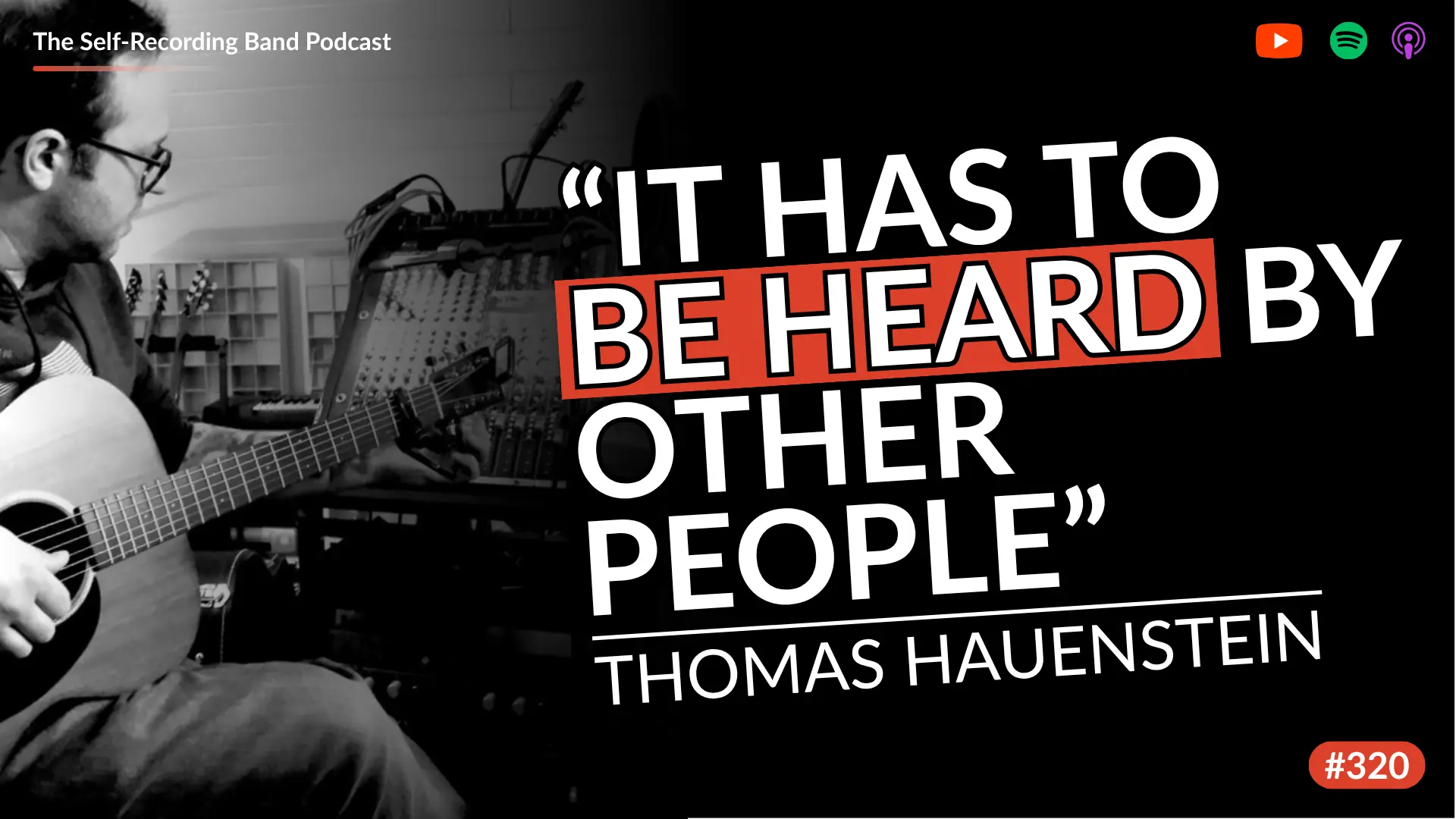
“It has to be heard by other people.”
That is the point.
A song sitting on a hard drive might mean something to you.
But it cannot affect anyone else.
Thomas explains that finishing a song lets him look back and say:
That was what I made at that point in time.
It’s done.
Now I can move on.
He also says he needs to get songs out of his head so there is room for the next thing.
That is one of the biggest hidden benefits of finishing:
Completion creates creative space.
Let Go Of Perfection
Thomas openly says he wants to release more and let go of perfection to a certain degree.
That does not mean releasing bad work.
It means recognizing that working longer does not automatically make something better.
There is always a point where more tweaking stops being improvement and becomes avoidance.
That line is difficult to find.
Especially when you are doing everything yourself.
But if your goal is for people to actually hear your songs, eventually you need to commit.
Acoustic Songs Can Be More Exposing Than Big Rock Productions
Thomas makes very different kinds of music.
Some songs are full rock productions with drums, fuzzy guitars, bass, and bigger arrangements.
Others are extremely stripped back.
One example is his song “Quiet,” which is essentially acoustic guitar and vocal.
Thomas says those acoustic songs often come together much faster and feel closer to the original emotional idea.
But fewer tracks do not necessarily mean fewer challenges.
With only one guitar and one vocal, every sound matters.
There is nowhere to hide.
A small EQ change can completely alter the mood.
A different microphone position can change the entire sense of intimacy.
And the performance has to carry the song.
Building An Acoustic Guitar Sound Through Experimentation
For “Quiet,” Thomas experimented extensively with recording his acoustic guitar.
He tried different stereo setups and eventually landed on an unusual combination:
A stereo Universal Audio Sphere microphone positioned in front of the guitar, combined with a close mono microphone near the neck to capture extra detail, finger noise, and high-frequency information.
It was not a textbook preset.
It came from listening, trying things, moving microphones, comparing results, and learning what different parts of the instrument contributed.
That process is valuable even beyond that one song.
Now Thomas has several acoustic guitar recording approaches he understands and can reuse when the next song calls for them.
You Need A Vision Before You Start Choosing Sounds
Thomas’s rock songs have a very distinct direction.
Fuzzy bass. Rock guitars. Relatively dry drums.
Influences that touch things like Queens of the Stone Age, Kyuss, and Foo Fighters.
And Thomas makes an important point:
If he does not have some idea of where he wants the sound to go, the number of available options becomes overwhelming.
You can try hundreds of plugins, hundreds of presets, hundreds of tones, but without a target, that freedom becomes a problem.
You need some kind of map.
It does not have to be fully formed.
But you need enough of a direction to recognize when something fits.
Ready To Transform Your Sound And Workflow?

Apply for professional mentoring and book a free clarity call with Benedikt to see if our programs are a great fit for you!
Programmed Drums Still Require Real Mixing Decisions
Thomas used Logic Drummer for some of his rock productions.
At first, it seemed simple:
Pick a drummer, choose a sound, done.
But once he split the drums into multiple outputs, he discovered something important:
The stereo preset that sounded great did not automatically sound great once everything was separated.
Now he had individual kick, snare, and other tracks.
And suddenly he had to actually mix the drum kit.
Compression, distortion, balance, EQ, phase, etc.
All the decisions that come with a real multitrack drum recording.
That process took work, but it also taught him much more about how drums actually function inside a mix.
Make Your Productions Harder To Copy
Thomas also recorded samples of his own acoustic drum kit before putting it away.
The idea was simple:
Capture something unique that he could potentially blend into programmed drums later.
That is a production philosophy I love.
Everyone has access to the same plugins. The same drum libraries. The same amp sims. The same presets.
But nobody else has your room, your old drum kit, your weird instrument, your dog shaking its collar, your mistakes, your environment.
The more of those elements you bring into a record, the harder it becomes for your music to sound exactly like everyone else.
Collaboration Means Giving Up Some Control
Thomas also talks about working with other musicians.
And one of the hardest parts for him is letting go of control.
That is understandable.
When you do everything yourself, you get used to making every decision.
Collaboration changes that.
Someone else may play something differently than you would.
They might suggest a different chord or hear the song another way.
And sometimes their idea may actually be better.
That requires trust.
But it can also create things you would never have made by yourself.
Doing Everything Yourself Has A Cost
Thomas writes, records, produces, mixes, creates artwork, posts about releases, and handles the other things around putting music into the world.
That gives him control.
But it also creates the biggest limitation:
Time.
There are only so many hours available.
Thomas talks openly about having too many ideas in progress and realizing that working on 15 things at once does not help him finish anything.
His current goal is to focus on fewer songs at a time and actually complete them.
That sounds obvious.
But it is surprisingly difficult.
Releasing The Song Is Only The Beginning
Thomas has also experimented with promoting his releases.
He creates artwork, posts on Instagram and Facebook, and starts talking about a release before it comes out.
And he notices the difference.
If he simply releases a song and does nothing else, attention disappears quickly.
Even a small amount of promotion can extend the life of the release and increase streams.
But again, this creates another job on top of making the music.
That is why expectations matter.
If music is not your full-time career, you need to decide what success actually means to you.
Thomas is not pretending he has endless time to become a full-time content creator and marketer.
He wants to make music he is proud of and get it heard. If only by a few people.
That is a perfectly valid goal.
It Has To Be Heard By Other People
That brings us back to Thomas’s quote.
“It has to be heard by other people.”
That is what finishing is for.
Because music is communication.
If you keep polishing forever, nobody gets to respond.
Nobody gets to connect.
Nobody gets to put the song on a playlist.
Nobody gets to tell you it meant something to them.
At some point, the best thing you can do for the song is finish it.
And let it leave the room.
Listen To The Episode
Episode 320: From Second-Guessing Every Mix To Finishing & Releasing Songs - Thomas Hauenstein
Watch The Episode
In This Episode
- Why Thomas struggled to judge his own mixes
- Developing your ears through feedback
- Knowing when a song is finished
- Letting go of perfection
- Why songs need to leave the hard drive
- Producing acoustic songs vs full rock arrangements
- Thomas’s acoustic guitar recording setup
- Using modeling microphones
- Creating fuzzy bass and guitar tones
- Programming and mixing with Logic Drummer
- Recording your own drum samples
- Adding unique sounds to your productions
- Collaborating with other musicians
- Learning to give up control
- The challenges of doing everything yourself
- Finishing more by focusing on fewer projects
- Promoting independent releases
- Setting realistic goals for your music
About Thomas Hauenstein
Thomas Hauenstein is a German solo artist, songwriter, and self-recording musician.
His music ranges from stripped-back acoustic songs to fuzzy, guitar-driven rock productions, and he writes, records, produces, and mixes much of the material himself.
Thomas is also a longtime member of The Self-Recording Syndicate, where he has worked on developing his recording, mixing, listening, and decision-making skills.
Instagram:
@thomas_hauenstein
Spotify:
https://open.spotify.com/intl-de/artist/6nAMfBQ1AaBes6fS5zLTXa?si=Koj1tD50RDqKN2v4IDD9LA
Apple Music:
https://music.apple.com/de/artist/thomas-hauenstein/1769947766
Want our personal help with your next music project?
If you want to finally finish songs and make them sound so good that you can't wait to share them with the world...
👉 Book a free first coaching session with us
We’ll listen to your music, look at your current situation, create a custom plan for you and figure out if you're a good fit for our coaching inside The Self-Recording Syndicate.
If you are, we can help you make records you're proud of and give you the skills and confidence to do it over and over again.
Recommended Free Downloads:
Standout Mixes – The DIY Musician’s Guide To Exciting Mixes That Connect
Follow And Connect With Us:
Outback Recordings (Benedikt's Mixing Studio and personal website)
Manel's Website
TSRB Instagram
Benedikt's Instagram
Manel's Instagram
If you have any questions, feedback, topic ideas or want to suggest a guest, email us at: podcast@theselfrecordingband.com