
What does mastering actually do?
For a lot of self-recording artists, the answer is something like:
Make it louder. Add some polish. Make it ready for Spotify.
And yes, mastering includes loudness and final delivery.
But that description misses most of what a great mastering engineer actually contributes.
More...
You've hit a wall with your audio skills and can't seem to improve your sound, no matter what you do?
See if you are a great fit for The Self-Recording Syndicate!
It is the number one way for DIY producers around the world to get results that they'll be proud of forever.
- Grow your audience with songs that don't sound "demo-y".
- Be taken seriously by your peers, fans and other musicians.
- Make records that sound as good as your favorite songs in your playlist.

Here's how to get there:
Apply for unlimited, personal 1-on-1 coaching (results guaranteed) - This is by far the fastest and best way to achieve your goals. Your gonna be working 1-on-1 with an experienced studio pro until your project is done. On your own songs, from your (home) studio and in your DAW of choice.
For Maor Appelbaum, mastering is about presentation.
You already have the picture.
The production and mix contain the song, performance, arrangement, tones, balances, and creative decisions.
Mastering changes how that finished picture is presented to the listener.
The overall tone. The contrast. The focus. The texture. The dynamics. The relationship between songs.
And, ultimately, how strongly the music connects.
Mastering Is Not Just About Loudness
One of the most common misconceptions about mastering is that its main purpose is simply making the mix louder.
Maor sees it very differently.
When he talks about creating “sounds with impact,” he is not primarily talking about level.
Impact means:
- Does the song pull you in?
- Does it connect emotionally?
- Does it make you listen more deeply?
- Does it leave a mark?
That may involve making it louder.
But it could just as easily involve making it darker, smoother, tighter, wider, more focused, or even less aggressive or quieter.
The correct direction depends on the music.
Mastering Is Presentation
Maor compares mastering to displaying a piece of art in a museum.
The artwork itself may already be finished.
But how it is framed, lit, and presented changes the way you experience it.
Music works the same way.
The mix may already contain everything it needs.
Mastering can then refine how that mix reaches the listener.
Sometimes that involves obvious changes.
Sometimes the best master requires very little processing at all.
The amount of processing does not determine the value of the mastering.
The question is whether the music is being presented in the best possible way.
Tiny Changes Can Still Matter
At the highest level, a lot of audio work comes down to very small decisions.
Maor describes the process as moving from large differences to smaller and smaller ones as your experience grows.
Eventually, you may be comparing changes that seem almost microscopic.
A fraction of a decibel. A slightly different converter. A tiny tonal change. A subtle difference in transient response.
Do listeners consciously notice every one of those decisions?
Probably not.
And Maor does not pretend they do.
But that does not necessarily mean the decision is pointless.
If making that final adjustment gets the result where you believe it should be, that can still matter.
Especially when many tiny improvements add together.
More Processing Does Not Mean Better Mastering
Maor has a huge amount of analog and digital gear available.
But that does not mean every song passes through every device.
Every tool changes the sound in some way.
EQ, compression, limiting. clipping, saturation, converters.
All of them leave some kind of fingerprint.
The goal is to decide whether a tool actually improves this particular song. Not to justify owning a piece of expensive gear.
Something that works beautifully on ten records may be wrong for the next one.
And sometimes the best decision is to remove something from the chain entirely.
How Mastering Changes The Way Music Feels
One of the most useful parts of our conversation is Maor explaining how technical decisions translate into emotion.
For example:
A tighter, punchier transient response can make a song feel more attacking and immediate.
A smoother response can make it feel more relaxed and inviting.
A brighter tonal balance can feel more open.
A darker balance can feel softer or more subdued.
More width can make a song feel expansive, while too much width can sometimes reduce punch.
Compression can make elements feel more connected.
Saturation can add excitement while also smoothing certain parts of the sound.
These are technical tools.
But the point of using them is not technical.
The point is how the listener experiences the music.
There Is No Universal Mastering Chain
If you are looking for the perfect mastering chain that works every time, Maor’s answer will probably disappoint you.
It does not exist.
Different songs need different things.
Different engineers hear differently.
Different artists want different results.
And different tools may fit different situations.
Some mastering engineers deliberately build a very small chain that becomes part of their signature sound.
Maor prefers having a much wider range of options and choosing based on the song.
Neither approach is automatically right or wrong.
What matters is knowing your tools and making decisions intentionally.
What Should You Expect From A Mastering Engineer?
The exact process depends heavily on who you work with.
Some mastering engineers communicate very little and simply return a great result.
Others have more back-and-forth with the artist or mixer.
Sometimes revisions are needed.
Sometimes mastering reveals something in the mix that should be fixed first.
Maor regularly hears issues more clearly once the mastering process begins.
In those cases, the best mastering move may actually be to go back and improve the mix.
So professional mastering is not necessarily a one-way process where you upload a file and receive a louder or better version.
It can be a collaboration.
Should You Think About Mastering While Mixing?
Maor’s advice is refreshingly simple:
Do your mix.
Make it sound the way you believe it should sound.
There used to be much stricter advice around leaving a specific amount of headroom.
Today, modern DAWs, plugins, and digital workflows can handle things differently.
That does not mean you should destroy your mix with unnecessary limiting.
It means there is no single technical number that automatically makes a mix “ready for mastering.”
If you already have a mastering engineer you trust, communication is more useful than blindly following internet rules.
Ask them what they prefer.
And if you like mixing into a limiter or other processing, you can often provide both the processed reference and a cleaner version.
Mixing Into A Limiter Is Not Automatically Wrong
Some great mixers work into limiting.
Others do not.
Some add loudness only after the mix is finished.
Maor has worked with all of these approaches.
He does not see one method consistently producing better mixes than the others.
The important part is consistency.
If you know how a particular limiter affects your balances and decisions, it can become a useful part of your workflow.
If it makes it harder for you to judge the mix, leave it off.
Again:
There is no universal rule.
Ready To Transform Your Sound And Workflow?

Apply for professional mentoring and book a free clarity call with Benedikt to see if our programs are a great fit for you!
A “Loud Mix” Is Not Necessarily A Master
This leads to an interesting distinction Maor makes in the episode.
A mixer may finish a mix and then apply enough two-bus processing to make it loud and competitive.
Some people call that a “mastered mix.”
Maor prefers the term loud mix.
Why?
Because the mastering process still adds an outside perspective.
It happens after the mix.
It can involve a different room, different monitoring, different tools, and most importantly, a different set of ears.
And Maor often masters mixes that already arrive loud.
Sometimes he even uses the loud version because the processing has become part of the artist’s preferred sound.
Other times, the less-processed version gives him more room to improve the result.
It depends on the material.
Why The Outside Perspective Matters
One of the hardest parts of mastering your own music is objectivity.
If you wrote the song…
Recorded it…
Edited it…
Produced it…
And mixed it…
You have heard it hundreds or thousands of times.
A mastering engineer enters much later.
That fresh perspective can reveal things you have stopped noticing.
Maor’s background helped him develop exactly that kind of listening.
Before focusing exclusively on mastering, he worked across many different parts of the music world, including engineering, music journalism, DJing, broadcasting, live sound, production, and playing in bands.
As a music journalist, he had to quickly understand what a record was communicating.
As a DJ, he learned how sequencing, transitions, and song placement change the way listeners respond.
Those experiences still influence the way he approaches mastering today.
Great Engineers Keep Learning From Other People
Maor never had a traditional mastering mentor.
But he did grow up around studios and other engineers and producers.
He worked with producer Sylvia Massy, among others, and describes that experience as part of his audio education.
That leads to a broader lesson.
You can learn a lot from courses, masterclasses, and videos.
One great lesson can completely change the way you hear something.
But long-term mentorship and collaboration expose you to something else:
Real projects.
Real problems.
Real decisions.
And the messy situations that rarely fit neatly into a tutorial.
That is where a lot of professional judgment develops.
Protect Your Hearing
If you are going to spend decades making music, your ears matter.
Maor has worked in loud environments as a musician and DJ and now takes hearing protection very seriously.
He uses different types of earplugs for different situations and recommends protecting yourself from unnecessary exposure.
He also points out that hearing changes with age are normal.
A hearing test may show dips or limitations that can be unsettling.
That does not automatically mean you can no longer make great records.
Your brain adapts.
Your experience matters.
And you can still train yourself to hear balances, tonal relationships, and other important aspects of music.
The important thing is to protect what you have.
What About AI Mastering?
Maor has a pragmatic view of AI.
He does not treat AI mastering as uniquely different from what is happening across the rest of the creative industry.
If technology becomes good enough for someone’s needs, some people will use it.
And that is not limited to mastering.
The same technology can learn mixing, production, songwriting, and other parts of the process.
What Maor believes will continue to matter is the human relationship around making music.
The collaboration.
The shared decisions.
The experience of working with people.
The community around the music itself.
And that becomes especially important in the final message he added after the episode had technically already ended.
Keep People In The Music
Maor closes the conversation with a point that goes beyond mastering.
Music survives because people participate in it.
Artists, engineers, producers, studios, listeners, collaborators.
When we constantly cut people out of the process purely to reduce cost, we also reduce the size and health of the music community.
His message is simple:
If you care about music, invest in it.
Work with people.
Collaborate.
Build relationships.
Keep the community alive.
Because the more people remain actively involved in making and supporting music, the longer that ecosystem can continue.
And the longer there will be exciting art made by humans.
Make Them Feel The Music
Ultimately, mastering is not about hitting a particular LUFS number.
It is not about owning the perfect compressor.
And it is not about applying the same chain to every song.
It is about taking a finished piece of music and asking:
How can this be presented in a way that makes the listener connect with it more deeply?
Sometimes the answer is loudness.
Sometimes it is tone.
Sometimes it is dynamics.
Sometimes it is width.
Sometimes it is almost nothing.
The tools change.
The goal stays the same:
Make them feel the music.
Listen To The Episode
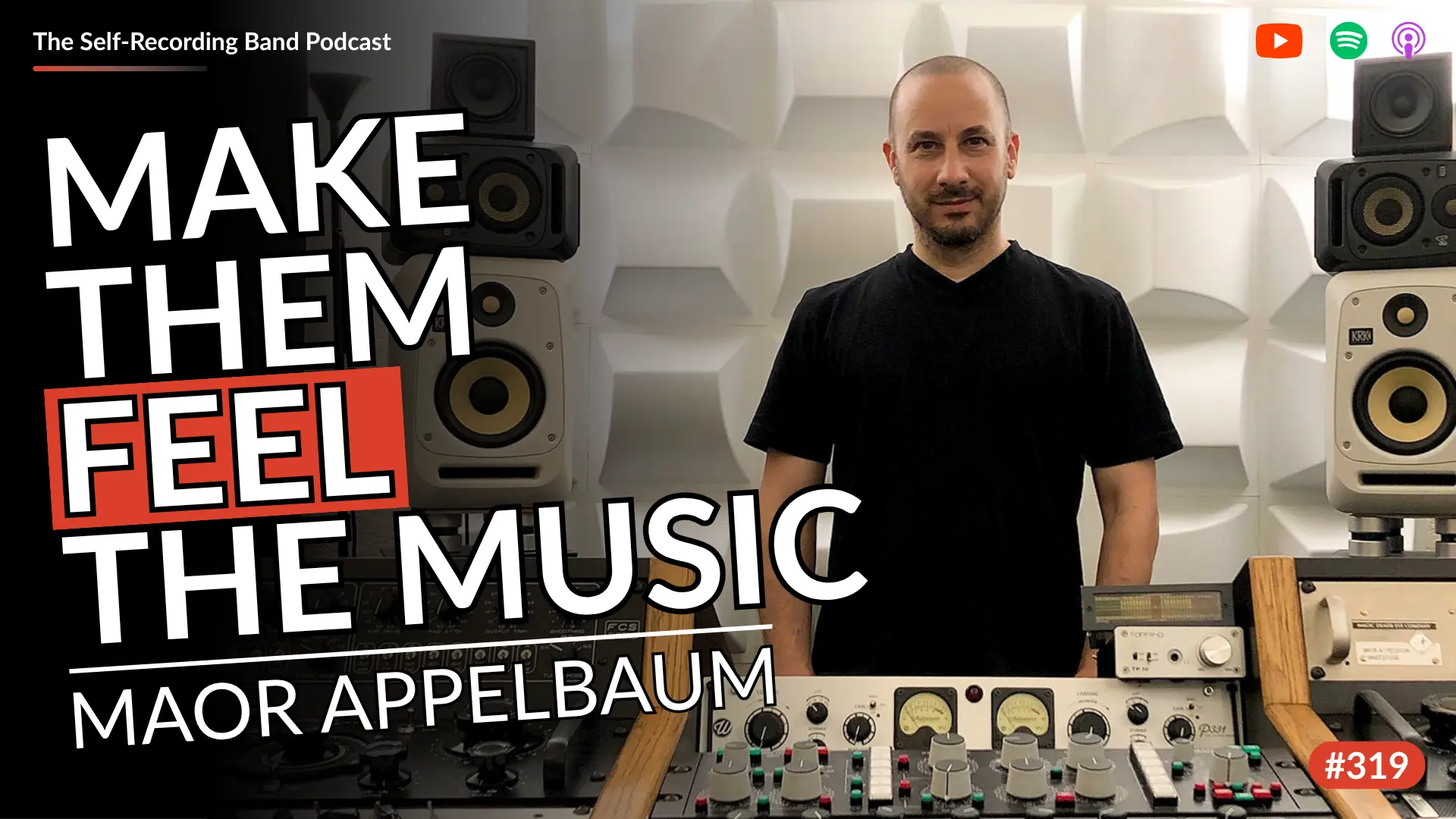
Episode 319: What Mastering Actually Does To Your Music - Maor Appelbaum
Watch The Episode
In This Episode
- What mastering actually does
- Why mastering is about presentation
- Emotional impact vs loudness
- How EQ, dynamics, width, and saturation affect feel
- Why tiny changes can still matter
- Why there is no universal mastering chain
- When mastering should do less
- What artists should expect from professional mastering
- Why mastering sometimes reveals mix problems
- Whether you should leave headroom
- Mixing into limiters and mastering chains
- The difference between a loud mix and a master
- Why outside perspective matters
- How Maor developed his ears, skills and taste
- Mentorship and learning from other engineers
- Hearing protection and aging
- AI mastering
- Why human collaboration still matters
About Maor Appelbaum
Maor Appelbaum is a mastering engineer who has worked with artists including Faith No More, Sepultura, Dream Theater, Yes, Meat Loaf, and many more.
His background spans recording studios, music journalism, DJing, broadcasting, live sound, production, and performing.
Experiences that shaped the way he listens to and presents finished music today.
Website:
maorappelbaum.com
Instagram:
instagram.com/maorappelbaummasteringtmao
Facebook:
facebook.com/maor1
The Sylvia Massy poster mentioned on the episode:
shop.sylviamassy.com/product/recording-unhinged-engineering-original-poster-signed-by-sylvia-massy
Want our personal help with your next music project?
If you want to produce your songs in a way that gets the emotion across and makes your vision for the music come out of the speakers...
👉 Book a free first coaching session with us
We’ll listen to your music, look at your current situation, create a custom plan for you and figure out if you're a good fit for our coaching inside The Self-Recording Syndicate.
If you are, we can help you make records you're proud of and give you the skills and confidence to do it over and over again.
Recommended Free Downloads:
Standout Mixes – The DIY Musician’s Guide To Exciting Mixes That Connect
Follow And Connect With Us:
Outback Recordings (Benedikt's Mixing Studio and personal website)
Manel's Website
TSRB Instagram
Benedikt's Instagram
Manel's Instagram
If you have any questions, feedback, topic ideas or want to suggest a guest, email us at: podcast@theselfrecordingband.com