What does a music producer actually do?
For some artists, the answer is still:
Record the band.
Choose microphones.
Make things sound good.
Mix the song.
But that only describes part of the job.
More...
You've hit a wall with your audio skills and can't seem to improve your sound, no matter what you do?
See if you are a great fit for The Self-Recording Syndicate!
It is the number one way for DIY producers around the world to get results that they'll be proud of forever.
- Grow your audience with songs that don't sound "demo-y".
- Be taken seriously by your peers, fans and other musicians.
- Make records that sound as good as your favorite songs in your playlist.

Here's how to get there:
Apply for unlimited, personal 1-on-1 coaching (results guaranteed) - This is by far the fastest and best way to achieve your goals. Your gonna be working 1-on-1 with an experienced studio pro until your project is done. On your own songs, from your (home) studio and in your DAW of choice.
For producer, guitarist, songwriter, and engineer Pablo Lopez Figueroa, the producer’s role startS much earlier.
An artist might arrive with nothing more than a rough guitar-and-vocal or piano-and-vocal demo.
From there, Pablo can help with the song itself, the arrangement, harmony, dynamics, instrumentation, recording, performances, editing, mixing, mastering, and bringing in additional musicians when the track needs them.
That makes the modern producer less of a technician and more of a person who helps guide the song from its starting point to a finished record.
And a lot of the most important work happens before you record.
It All Happens Before You Record
Modern recording gives us almost unlimited options.
We can change tempos. Change keys. Replace drums. Move sections. Add instruments. Remove instruments. Tune vocals. Edit performances. Try another amp. Try another plugin. Try another arrangement.
That flexibility is useful.
But it can also make decision-making much harder.
Pablo’s answer is to put serious attention into pre-production.
For him, pre-production includes decisions about:
- song structure
- tempo
- key
- dynamics
- instrumentation
- vocal melodies
- harmony
- contrast between sections
- the overall direction of the production
Those decisions create the foundation.
Once they are clear, recording becomes much easier because you are no longer trying to simultaneously write, arrange, produce and engineer the song while the clock is running.
A Better Production Cannot Fix A Song That Has No Contrast
One idea Pablo returns to throughout the episode is contrast.
A song needs differences.
That might mean contrast between verse and chorus.
It might come from rhythm. Melody. Dynamics. Harmony. Instrumentation. Or vocal delivery.
For example, if the vocal uses roughly the same rhythmic pattern and melodic range throughout the entire song, it may be difficult to hold the listener’s attention.
Likewise, if every section has roughly the same intensity, the chorus may technically arrive without ever feeling like the chorus arrived.
The goal is not to follow a formula.
There is no universal rule saying a chorus must always be higher, louder or busier.
The point is simply to be intentional about what makes one section feel different from another.
There Is No Single “Right” Production Choice
Pablo is careful not to frame music production as a list of rules.
Something that sounds objectively wrong in one context may become the thing that makes another record exciting.
Production trends change.
Genres change.
Taste changes.
And sometimes breaking a conventional rule creates exactly the character a song needs.
In the rapid-fire section of the episode, Pablo gives a perfect example.
He once intentionally overloaded a basic interface preamp to create an ugly distortion, then blended that distortion into a guitar sound.
Technically clean?
No.
Useful for the song?
Yes.
That distinction matters.
The producer’s job is to help make decisions that serve the record.
Not to make everything technically perfect.
The Producer’s Idea Does Not Need To Win
Pablo and Manel studied music together in Dublin and have remained close friends and collaborators ever since.
One thing Pablo says they share is that neither of them needs their own idea to be the idea.
They can try multiple versions.
Throw things away.
Change direction.
And move on without treating every suggestion as part of their identity.
That is an important production skill.
If every person involved is emotionally attached to proving that their own idea is correct, collaboration becomes difficult.
A producer needs taste and opinions.
But they also need to be able to ask:
What is actually best for the song?
Sometimes the artist’s original idea wins.
Sometimes the producer’s suggestion wins.
Sometimes a third option appears that neither person had imagined before the session.
The outcome matters more than who gets credit for the idea.
Working With A Producer Should Fill The Gaps
Different artists need different things.
One artist may already write great songs but need help making production decisions.
Another might be technically comfortable recording at home but struggle with arrangement.
Someone else may have strong musical instincts but need help with harmony.
Another band may have everything figured out creatively and simply need someone to engineer, mix and master the record.
That is why Pablo describes his ideal service as something close to a one-stop shop.
The artist brings the starting point.
The producer helps identify the gaps.
Then the right people, tools and skills are brought in to move the project forward.
Bands Need A Clear Decision-Making Process
Producing a solo artist can already involve a lot of decisions.
A band adds several more people to the process.
That can become a problem when everyone sends separate feedback.
The guitarist wants more guitar.
The bass player wants more bass.
The drummer wants louder drums.
And suddenly the producer is trying to combine multiple conflicting versions of the same record.
Pablo recommends something simple:
Designate one musical director.
That does not mean only one band member gets an opinion.
The band can still discuss everything internally and make decisions together.
But one person becomes the communication point between the band and the producer.
That helps reduce contradictory feedback and forces the band to resolve disagreements before sending revisions.
The result is usually faster and clearer decision-making.
Faster Decisions Can Lead To Better Records
The ability to keep changing things forever does not mean you should.
At some point, every project needs commitment.
Pablo argues that, in general, making decisions more quickly can help preserve momentum.
That becomes easier when the project has already gone through thoughtful pre-production.
You know what the song is trying to do.
You know what the important sections are.
You have an idea of the instruments and direction.
So when a choice comes up, you are evaluating it against an established vision instead of starting again from zero.
The goal is not to rush.
It is to avoid keeping every possible door open forever.
Great Production Is Also About People
Music production is not only technical and creative.
It is deeply personal.
Artists may walk into a session feeling insecure about their voice, their playing, the song, or whether they belong in a professional studio at all.
Pablo believes the producer has a responsibility to create an environment where people can work comfortably.
That can involve seemingly small things.
Keeping the studio clean.
Making the room welcoming.
Being aware of what makes a particular artist comfortable or uncomfortable.
Listening.
Being empathetic.
And creating space for difficult conversations when they need to happen.
A producer is not a therapist.
But the atmosphere they create can have a direct effect on the performances and decisions that happen in the room.
Community Makes Producers Better Too
Pablo’s relationship with Manel is a big part of his story.
They met while studying music in Dublin and quickly realized they were both serious about improving.
They attended masterclasses.
Booked as many tutorials as they could.
Practiced.
Played together.
Shared information.
Pushed each other.
And continued collaborating after university.
Pablo describes that relationship as an important source of both inspiration and accountability.
That same idea is one of the things he values most about The Self-Recording Syndicate.
Producing, mixing and engineering can be isolating jobs.
You might spend most of your working day alone in front of a computer.
Having a community gives you people who actually understand the problems you are working through.
It gives you access to people that you can ask about songs, production, business, gear...
Or whatever problem happens to be in front of you that week.
Pablo is also a member of our Studio Growth Mastermind, where studio owners meet weekly to exchange ideas, help each other solve problems, and move their creative businesses forward.
Your Studio Is Only As Good As The Room
Pablo has also recently built a new studio space.
And one of his biggest takeaways is simple:
Do not underestimate acoustics.
Expensive monitors cannot compensate for a room that prevents you from hearing what those monitors are actually doing.
Pablo built roughly 28 acoustic panels during the process of developing his room and has been measuring and adjusting the setup to improve its performance.
His recommendation is to prioritize acoustics before assuming that more expensive monitors will solve your problems.
And if proper acoustic treatment simply is not realistic yet, a trustworthy pair of headphones may be a more useful investment than putting expensive monitors into an untreated room.
What Artists Actually Need From A Modern Producer
A modern producer can wear a lot of hats.
Songwriter, arranger, musician, engineer, editor, mixer, mastering engineer, creative partner, project guide.
But the important part is not how many skills they can list.
It is whether they can help the artist make better decisions and move the song forward.
Sometimes that means solving a technical problem.
Sometimes it means rewriting part of the arrangement.
Sometimes it means telling the artist that the song does not need another instrument.
And sometimes it simply means helping everyone commit to a decision and move on.
The recording button is only one part of making a record.
A lot of what determines the final result has already happened before anyone presses that button.
Listen To The Episode
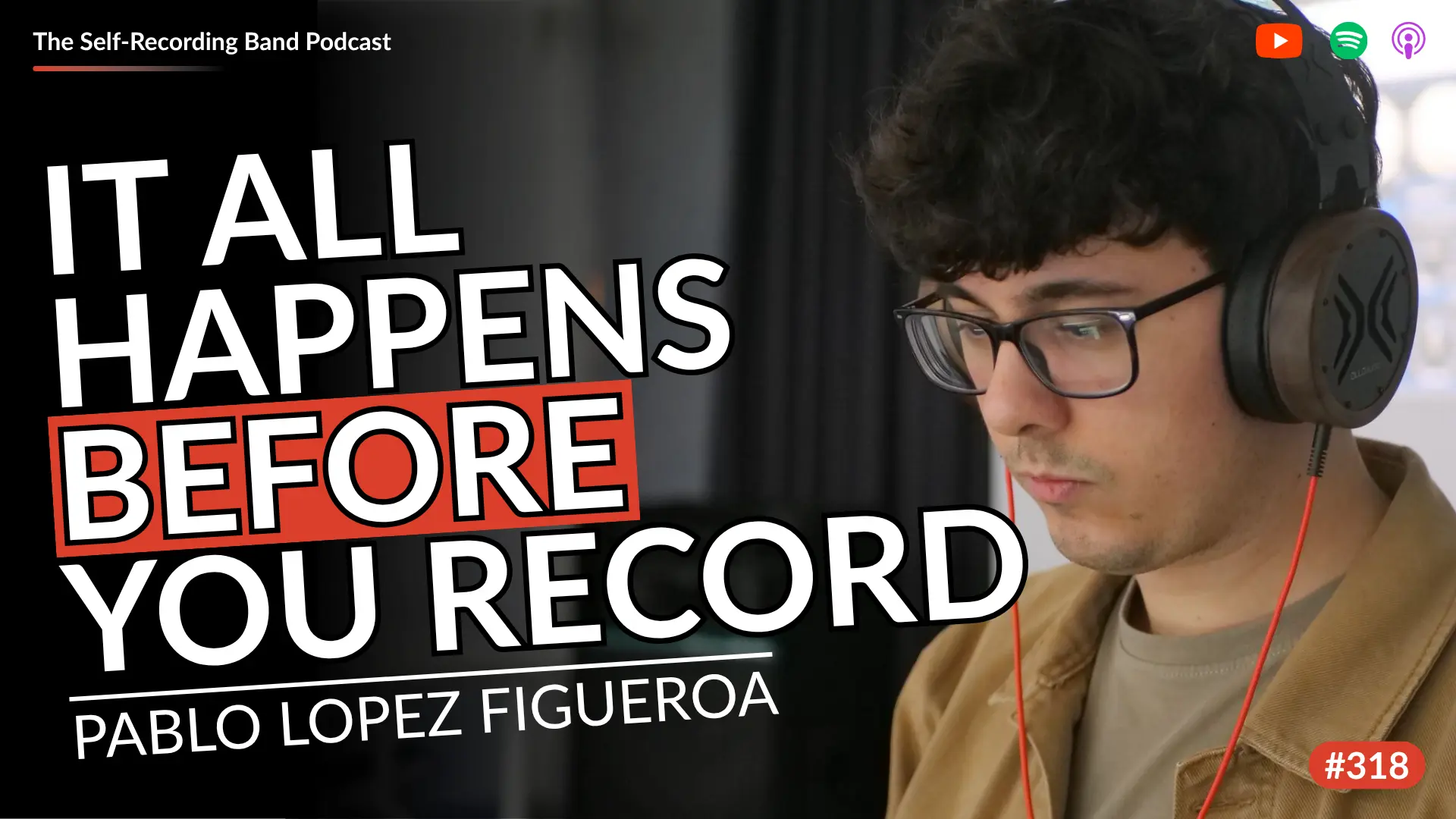
Episode 318: What Artists Actually Need From A Modern Music Producer - Pablo Lopez Figueroa
Watch The Episode
In This Episode
- What a modern music producer actually does
- Turning rough demos into finished records
- Why pre-production matters so much
- Building contrast into songs
- Song structure, tempo, key and arrangement decisions
- Why there is no universal “right” production choice
- Keeping ego out of the creative process
- Why the producer’s idea does not always need to win
- Working efficiently with bands
- Using a musical director to simplify communication
- Avoiding endless revisions and creative indecision
- Creating a comfortable recording environment
- Working with artists who struggle with insecurity
- Why community and accountability accelerate growth
- Pablo and Manel’s journey studying music in Dublin
- Why acoustics matter more than expensive monitors
- Building a professional recording studio on a realistic budget
About Pablo Lopez Figueroa
Pablo Lopez Figueroa is a Spanish music producer, guitarist, songwriter, engineer and teacher.
He works with artists across the full record-making process, helping take ideas from early demos through pre-production, arrangement, recording, production, mixing and mastering.
Pablo is also a member of The Self-Recording Syndicate and the Studio Growth Mastermind.
Website:
Instagram:
instagram.com/pablopezfi
YouTube:
youtube.com/@pablopezfi
Want our personal help with your studio or your next music project?
If you want to surround yourself with like-minded, ambitious artists and producers like Pablo and Manel...
👉 Apply for coaching:
theselfrecordingband.com/coaching
You'll get our unlimited, personal guidance.
Depending on what your goals are, we can help you make records you're proud of, or build and grow the studio business you've always wanted.
We’ll listen to your music, look at your current situation, create a custom plan for you, and help you execute it step by step.
Ready To Transform Your Sound And Workflow?

Apply for professional mentoring and book a free clarity call with Benedikt to see if our programs are a great fit for you!
Recommended Free Downloads:
Standout Mixes – The DIY Musician’s Guide To Exciting Mixes That Connect
Follow And Connect With Us:
Outback Recordings (Benedikt's Mixing Studio and personal website)
Manel's Website
TSRB Instagram
Benedikt's Instagram
Manel's Instagram
If you have any questions, feedback, topic ideas or want to suggest a guest, email us at: podcast@theselfrecordingband.com